Secure systems.
Original AI.
Honest engineering.
Imortek builds specialist software for organisations whose problems ordinary tools do not solve — in security, defence, government and research. An operating system for equipment that cannot be patched quickly. A decompiler for binaries nobody has the source to. An Artificial Intelligence (AI) architecture derived from first principles rather than wrapped around someone else’s model. Every claim on this site is backed by a test, a benchmark, or an honest note about what does not work yet.
github.com/odin-loki
connecting…ParanoidBSD
A hardened Berkeley Software Distribution (BSD), rewritten in C++23, with a capability and handle nucleus sitting on top of what HardenedBSD already ships — and KDE Plasma 6 on the desk.
Memory-unsafe C is the substrate almost every operating system still runs on. PBSD takes HardenedBSD 15-STABLE as a behavioural specification and ports it, file by file, to C++23 modules — then adds a security nucleus where every resource is reached through an unforgeable handle rather than an ambient global namespace.
- Ported faithfully, not “improved”. The HardenedBSD tree is the spec. Bugs are ported too, until a change is logged separately.
- Nothing is done until it is verified. Compile-only is unverified. Differential or Intermediate Representation (IR) verification gates every file.
- Deterministic tooling first. Safe rewrite passes run before any model touches code — and the model never self-certifies.
- Freestanding kernel C++.
-fno-exceptions -fno-rtti, with a documented kernel Application Binary Interface (ABI).
Illustrative reconstruction of the migration driver’s output. Real logs live in docs/migration/.
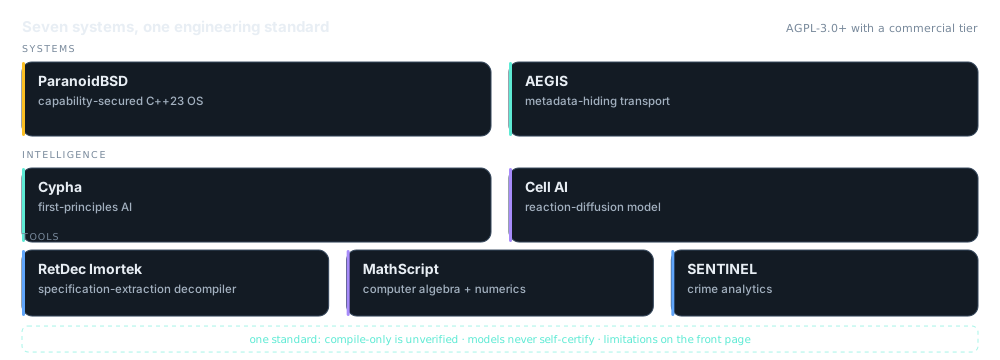
Seven systems, one engineering standard
Each of these is a real repository with real tests. Each page below carries a working, interactive demonstration of the idea underneath it — running in your browser, no install, no sign-up.
ParanoidBSD
C · C++23 · operating systemHardenedBSD 15-STABLE ported to C++23 modules with a capability/handle security nucleus and KDE Plasma 6. Interactive: walk a syscall through the nucleus.
Open PBSDCypha
C++ · AI architectureOne type that classifies, regresses, samples latents and generates tokens. Derived from MDL priors, natural gradient and the information bottleneck. Interactive: train a live classifier by clicking.
Open CyphaRetDec Imortek
C++ · decompilerRecovers algorithms, crypto primitives, concurrency patterns and serialization formats — not just pseudocode. Qt 6 GUI, optional offline neural refinement. Interactive: lift bytes to a named algorithm.
Open RetDec ImortekMathScript
C++23 · computer algebraLinear algebra, special functions, ODE/PDE/FEM/CFD, optimisation, signal processing and a symbolic CAS — with LU/QR/SVD in-tree, no Eigen, no OpenBLAS. Interactive: plot and differentiate live.
Open MathScriptAEGIS
Rust · anonymity transportHides who talks to whom, when, and how much — against a global passive adversary. Constant-rate Sphinx mixnet plus a tunable bulk plane. Interactive: run the correlation attack yourself.
Open AEGISSENTINEL
C++23 · Qt 6 · crime analyticsPoisson and Hawkes models, DBSCAN series detection, KDE hotspots and Rossmo geographic profiling — every lead traceable to its source record. Interactive: build a hotspot surface from clicks.
Open SENTINELCell AI
Python · sequence modelReaction-diffusion partition dynamics with Hebbian/BCM plasticity running during the forward pass. Documented honestly, failures included. Interactive: run the reaction-diffusion field.
Open Cell AITRACE
C++23 · multi-target trackingPersistent identity from sparse sightings — existence as a probability, not a boolean, so a track survives the gap where nothing can see it. Interactive: the engine itself, in WebAssembly.
Open TRACEThe research shelf
Ideas · R&DCryptography, long-context memory, tracking filters, GF(2) ring theory, field-gravity models, carbide tooling, energy macroeconomics. A shelf, not a product catalogue — and labelled as such.
Browse the shelfThe standard, stated plainly
Independent software has a credibility problem, and it is usually earned. These are the rules the repositories are actually held to — you can check every one of them against the source.
Compile-only is not done
In PBSD, no ported file counts as finished until differential or IR verification passes. In MathScript, correctness is 816 CTest suites against committed goldens. In Cypha, parity with fixture goldens — not a leaderboard number — is the proof.
Models fill gaps; they never certify
AI is used where it earns its place — porting refused files, refining decompiler output — and it is always downstream of deterministic tooling and upstream of a hard gate. Compile checks, sanitizers, differential runs and IR comparison decide, not the model.
Limitations are published, not buried
Cell AI’s perplexity is orders of magnitude worse than a transformer, and its README says so. AEGIS states that clearnet exit is weaker and that multi-second latency is inherent. RetDec’s name-blind algorithm F1 is 0.056, printed next to the 1.000 name-assisted figure. That is the point.
Measurement beats intuition
AEGIS was built to a single rule: nothing is done until an attack simulation
confirms it. Intuition about traffic analysis failed repeatedly during development;
the simulation harness in sim/ is the evidence ledger behind every
quantitative claim in the specification.
What moved most recently
Pulled from the GitHub API when you loaded this page. If it is quiet, it is quiet — there is no marketing layer between you and the commit history.
Recent pushes
loadingFree for almost everyone. Paid where it pays.
Everything Imortek publishes is source-available under the GNU Affero General Public License v3.0 or later, with a tiered commercial licence for organisations that need to keep their modifications private.
- Free under AGPL-3.0+ for personal use, charities, education, and any organisation earning under 50,000 Australian dollars (AUD) a year.
- Commercial licence above that threshold, tiered by size, with no obligation to publish your modifications.
- Every repository in the catalogue carries these terms today — it is not a plan, it is what the LICENSE files say.
/* In your about box, docs, or footer: */
"Powered by Ideas, developed by Odin Loch.
 Licensed under AGPL-3.0+."
Under AGPL you must also share your modifications back under the same dual licence, and research built on the software must be open-sourced. A commercial licence removes both requirements.
The PBSD Kickstarter is open
The port is running. What it needs now is the AI credits and verification compute to finish it. The goal is AUD 10,000, the campaign is all-or-nothing, and every assumption behind that number is laid out and adjustable on the campaign page.