An operating system where authority is held, not assumed
Nearly every break-in works the same way: a program reaches something it was never meant to touch. ParanoidBSD is an operating system built so that it cannot. Each program is handed only what it needs, and everything else is not merely forbidden — it is out of reach. Built on HardenedBSD, rewritten in modern C++, with the original kept alongside so every change can be checked against it.
What this is, in one minute
An operating system sits underneath everything else an organisation runs. Most are built on decades of older code, and they let any program ask for anything at all — the system decides afterwards whether to allow it. That is why one flaw in something harmless, like the code that draws a font on screen, can end with stolen passwords.
ParanoidBSD changes what a program is able to ask for in the first place. Rather than checking permission after the request, it hands each program a short list of things it may touch, and gives it no way to name anything else. A flaw in one part stops being a route into the rest.
Defence and government suppliers now being asked for software written in safer languages. Equipment that stays in the field for years and cannot be patched quickly — factory controllers, medical machines, utility hardware. Teachers and researchers who want a real operating system small enough to read end to end.
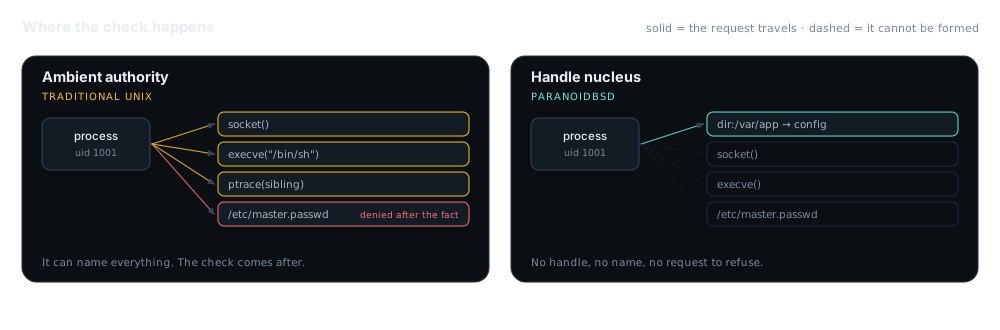
Ambient authority is the bug you cannot patch
On a conventional Unix, a process does not hold the right to open
/etc/master.passwd. It simply asks, and the kernel decides afterwards,
based on who the process claims to be. Every process can name every resource on the
system. The name space is global and ambient; the check is a late afterthought.
That is why a single parsing bug in a font renderer can become a credential theft. The renderer never needed the password file — but nothing in the architecture stopped it from asking.
HardenedBSD already does serious work here: Address Space Layout Randomisation (ASLR), which loads a program somewhere different every time so an attacker cannot guess where anything is; Control Flow Integrity (CFI), which stops a program being steered into code it was never built to run; and PaX-derived mitigations, SafeStack and hardened memory allocators alongside them. PBSD keeps all of it and changes the shape of the question underneath — from “is this process allowed?” to “does this process hold a handle to that?”
Two ways to answer one syscall
// Ambient authority — the traditional path
int fd = open("/etc/master.passwd", O_RDONLY);
// kernel walks a global namespace, then
// checks uid/gid/MAC after the fact

// Handle nucleus — the PBSD path
auto f = dir_handle.open("master.passwd", Rights::Read);
// there is no global namespace to walk.
// no handle, no name, no operation.
Illustrative shape of the difference, not a verbatim listing of the calls a
program makes into the kernel — its Application Programming Interface, or API.
The authoritative model is in docs/.
Walk a syscall through the nucleus
Give the process some handles, pick something for it to attempt, and switch between the two authority models. The verdict and the reasoning are computed live in your browser — this is a teaching model of the design, not a kernel emulator.
Capability nucleus — reference monitor
The process attempts…
Trace
Handles held by the process
Verdict
“Reachable” counts how many of the listed operations this process could perform at all under the current model. Under ambient authority, reachability is decided by identity; under the nucleus, by the handles it actually holds.
pbsd/; the specification is in
docs/specs/.
Four stages, and a model that never certifies itself
Porting a Berkeley Software Distribution (BSD) userland and kernel to C++23 by hand is a decade of work. Porting it by asking a language model to rewrite files is a fast way to produce plausible garbage. PBSD does neither.
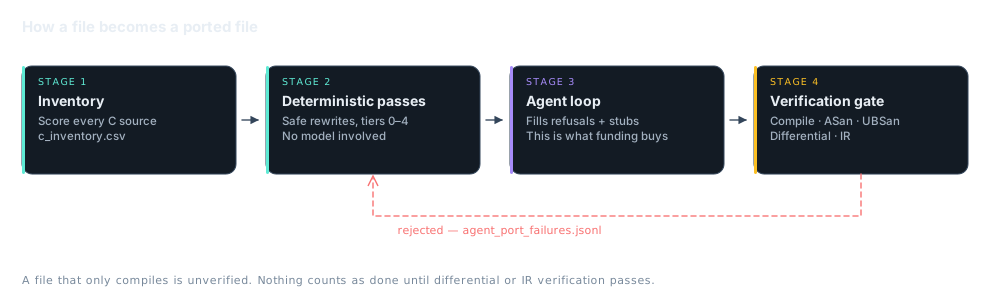
Inventory
tools/inventory_c_sources.py and clang_cxx23_port.py score
every C file by difficulty and write c_inventory.csv. Nothing is guessed
about scope.
Deterministic passes
run_todo_passes.py applies safe mechanical rewrites in tiers 0–4.
No model involved. Anything a pass refuses is logged to
refusals.jsonl rather than forced.
Agent loop
pbsd.py fills stubbed and refused files with DeepSeek Flash escalating
to Pro at maximum reasoning effort — 48 Flash and 24 Pro workers by default.
This is what the Kickstarter funds.
Verification gate
Compile, ASan, UBSan, differential execution and comparison at the level of the
compiler’s Intermediate Representation (IR). A file that only compiles is
unverified. Failures land in
agent_port_failures.jsonl.
A port is a claim of equivalence
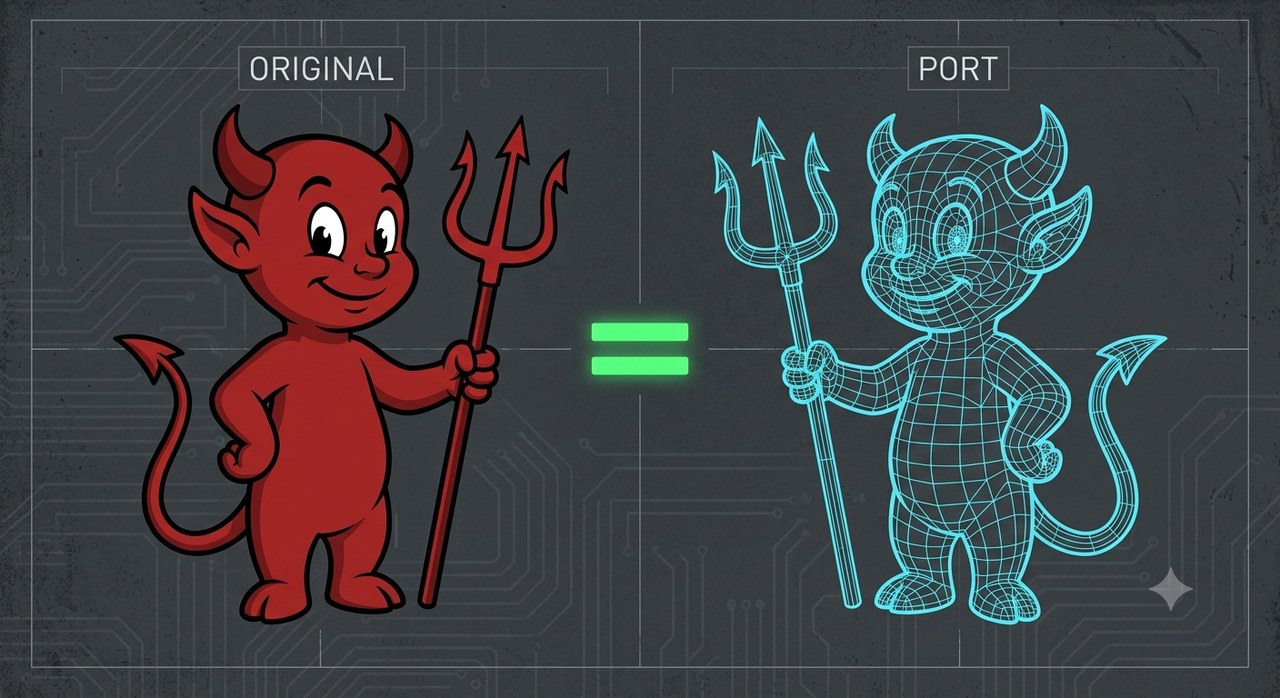
Saying a file has been ported is saying the new one behaves like the old one. That is a claim, and claims need evidence. A C++23 rewrite that compiles is a plausible-looking wireframe; it is not yet the same daemon.
So the equals sign is the gate. Differential execution runs both and compares observable behaviour. IR comparison checks they mean the same thing to the compiler. Until one of those passes, the file stays open in the migration log and does not count toward progress — however finished it looks.
Rules the repository is actually held to
No file is done until differential or IR verification passes
Port faithfully — do not silently “fix” bugs in the original
Deterministic tooling first; models fill only what remains
Kernel C++ is freestanding: -fno-exceptions -fno-rtti
docs/specs/KERNEL_CXX_ABI.md so that a
contributor can tell what is legal in kernel context without guessing.
Every module needs a provenance entry before it counts as done
docs/PROVENANCE.md records where each module came from and under which
licence. This is what makes the licensing statement below verifiable rather than
aspirational — you can check, module by module, which code is HardenedBSD-derived
and which is new PBSD work.
Two licences, honestly separated
New PBSD code — the nucleus, the C++23 modules, the tooling — is offered under Imortek’s standard terms: the GNU Affero General Public License (AGPL-3.0+), free for personal use, charities, education and organisations under 50,000 Australian dollars (AUD) a year, with a tiered commercial licence above that.
Code derived from HardenedBSD stays under its original BSD licence. It cannot be
relicensed and Imortek does not claim to. docs/PROVENANCE.md is the
record of which is which.
New PBSD work
pbsd/, tools/, scripts/, the capability nucleus, UDA, BIFROST, compositor and theme.
HardenedBSD-derived
hbsd/ and every ported file tracing back to it. Original terms, original attribution.
An operating system that is harder to break into
Most break-ins exploit the same kind of mistake: a program reaching memory it was never meant to touch. ParanoidBSD rebuilds a trusted system in a language that makes that mistake much harder, and hands every program only the access it actually needs.
Defence and government suppliers
Buyers are starting to insist on software built in languages that shut out whole classes of attack. Starting again from nothing costs a decade. This moves a proven system across instead, and keeps a written record of every file it changed and how that change was checked.
Equipment that stays in the field for years
Factory controllers, medical machines, utility hardware. When a flaw turns up you often cannot just push an update. This limits how far an intruder gets once they are in, because no program can reach past what it was handed.
Universities and security researchers
A real operating system, small enough to read end to end, with the original sitting beside it to compare against. Useful for teaching and for testing ideas on something that actually runs.
The port runs on compute it does not have
Deterministic passes are free. The agent loop that fills the residue — and the verification runs that gate it — are not. That is the entire ask.