Free for almost everyone. Paid where it pays.
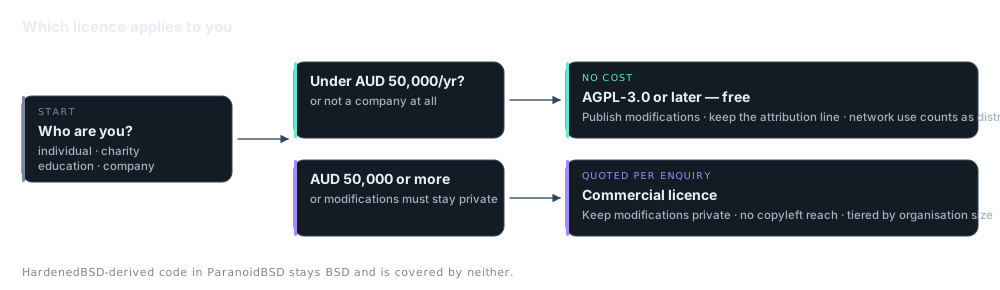
Everything Imortek publishes is source-available under the GNU Affero General Public License v3.0 or later. If you are a person, a charity, a school, or an organisation earning under 50,000 Australian dollars (AUD) a year, that costs you nothing. Above that threshold, or if you need to keep your modifications private, there is a tiered commercial licence.
AGPL-3.0 or later
Personal use, charities, education, and organisations under AUD 50,000 annual income. Share your modifications back, open-source research built on it, and keep the attribution line.
Commercial licence
Tiered by organisation size. No obligation to publish your modifications, no copyleft reach into your own code, and no attribution requirement unless you want one.
Six ways an organisation can work with Imortek
Licensing is one of them, and it is the one this page goes on to explain in detail. Here are the other five first, because most people arrive with a problem rather than a legal question.
Technology deployment
Take something already built and put it to work where you are. The systems on this site are public, tested and documented, and each page says what its software does today and what it does not. If one of them fits, the work is installation, your own data, and the parts that only break under real conditions.
Commissioned development
These systems were built to be general. An operational requirement never is. Where something is close to what you need but not aimed at it, it can be adapted — a different data format, a model fitted to your problem, an interface built around how your people actually work. Scoped and quoted before any of it starts.
Research partnership
Some of this work is research and is labelled as research. Where an approach looks promising but is unproven, the honest way to settle it is to test it together: you bring the problem and the data, this side brings the implementation and the measurement. Findings are written down either way, negative ones included.
Licensing
Put Imortek technology inside your own product or infrastructure. Everything here is AGPL-3.0+ by default, which suits open work but reaches into the code you build around it. A commercial licence removes that reach and the duty to publish your modifications. Per-project is the normal case. The rest of this page is the detail.
Investment
There is no team, no investor money to spend down and no growth plan behind this work, and the about page says so plainly. What money buys here is time and compute. The ParanoidBSD campaign is the public version of that ask — AUD 10,000, all-or-nothing, with every assumption behind the figure laid out and adjustable. For anything larger, email and say what interests you.
Technical evaluation
Test it against your own data before anyone signs anything. Beta access is free: no contract, no Non-Disclosure Agreement (NDA), no account. You send an email, you get the software and a short note on what would help most. If it falls over on your data, that is the result worth having, and it is the one that changes the software.
Which licence do you need?
Four questions. The answer is computed in your browser and nothing is recorded. This is a guide to the terms, not legal advice — the licence texts govern.
licence chooser
Result
What that means for you
Side by side
| AGPL-3.0+ | Commercial licence | |
|---|---|---|
| Cost | Free | Tiered by organisation size |
| Who it is for | Individuals, charities, education, organisations under AUD 50,000 a year | Everyone above that threshold |
| Use in a product | Yes | Yes |
| Modify the source | Yes | Yes |
| Must publish your modifications | Yes, under the same dual licence | No |
| Network use triggers source obligations | Yes — this is the “A” in AGPL | No |
| Research built on it | Must be open-sourced | No obligation |
| Attribution line required | Yes | Optional |
| Support | Best effort, via GitHub issues | Direct, by arrangement |
The line AGPL users must carry
In your about box, documentation, or footer:
Powered by Ideas, developed by Odin Loch.
Licensed under AGPL-3.0+.
Upstream code in ParanoidBSD is not relicensed
ParanoidBSD vendors two upstream trees and ports from both. hbsd/ stays under
HardenedBSD’s and FreeBSD’s own terms; kde/ stays under
KDE’s. Neither can be relicensed and Imortek does not claim to. Ported files under
pbsd/ keep the upstream copyright header they inherited, and that header
governs the file — it beats the per-path default.
LICENSING.md is the authoritative per-path map, and
docs/PROVENANCE.md records which modules are ported and which are new PBSD
work, so the boundary is checkable rather than asserted. New work — the capability
nucleus, the tooling, the compositor and the Aero theme — carries the Imortek dual
licence.
pbsd/zfs/ derives from OpenZFS, which is under the Common Development and
Distribution License (CDDL) and has no compatibility route to the AGPL — ZFS stays
a separate unmodified module. And the KDE-derived work is compatible only through the
“or later” clause, so code under the GNU General Public License version 2.0
alone (GPL-2.0-only) must never enter the tree. All three are listed in
NOTICES.md and enforced by a Continuous Integration
(CI) check.
What each repository carries today
The catalogue is now on one licence. Every repository below carries AGPL-3.0+ with the commercial tier, and the last column records what each one was before, because a licence change is the kind of thing people deserve to be told about rather than have quietly swapped underneath them.
| Project | Licence | Status | Note |
|---|---|---|---|
| Ideas — research shelf | AGPL-3.0+ / commercial | In place | — |
| RetDec Imortek | AGPL-3.0+ / commercial | In place | — |
| ARIA-INTEL | AGPL-3.0+ / commercial | In place | — |
| Cypha | AGPL-3.0+ / commercial | In place | was Creative Commons (CC) BY 4.0 |
| MathScript | AGPL-3.0+ / commercial | In place | was unlicensed · vendor/ excluded |
| AEGIS | AGPL-3.0+ / commercial | In place | was proprietary |
| SENTINEL | AGPL-3.0+ / commercial | In place | was MIT |
| Cell AI | AGPL-3.0+ / commercial | In place | was unlicensed |
| ParanoidBSD | AGPL-3.0+ / commercial for new work | Split, permanently | hbsd/ and kde/ excluded; per-file headers govern |