Research shelf / Defence & security / Threat assessments
Written Updated
Three open-source threat briefs, written in intelligence register
A threat assessment is a specific document genre: an executive summary, a capability characterisation, an attribution discussion, and a countermeasure section, written so an analyst can act on it. These three are exercises in that genre, built from open sources and banner-marked UNCLASSIFIED — open-source research, not classified material.
Theory or design only. No in-house measurement.
Hypothetical intelligence briefs on identity-replacement tradecraft, neurological interference and an explosive mixture — written from open sources in the register such documents actually use.
The physical identity replacement brief characterises the capability tier at which biometric, visual and voice identification can be defeated by physical modification, and the infrastructure a capability at that tier requires — which is the analytically useful part, because it bounds who can plausibly do it. Its central distinction is between reversible short-duration kit and permanent modification for long-term cover, since the two imply very different preparation footprints.
The neurological interference brief covers reported directed-energy and acoustic health-incident claims, and the 2NT/TNT mixture brief covers an explosive characterisation. Both are written in the same structure: what the capability is, what evidence exists in open sources, what the attribution picture looks like, and what detection or countermeasure options follow.
The register is deliberate. Genre fidelity — classification banners, versioned documents, executive summary first — is the point of the exercise, in the same way the defence portfolio’s traceability discipline is the point there. These are unclassified open-source syntheses and are marked as such at the top of each document.
Every number, and what stands behind it
A claim is only worth the evidence attached to it. Each row below carries its basis: measured on the author’s own hardware, derived from the construction, measured on synthetic data, projected from literature, or simply cited.
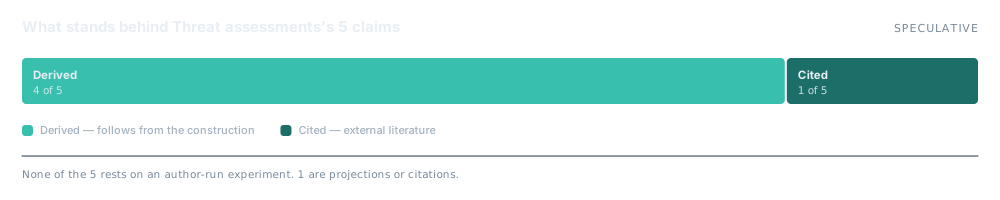
| Claim | Figure | Basis | Context |
|---|---|---|---|
| Briefs in the folder | 3 | Derived | Identity replacement, neurological interference, explosive mixture |
| Source basis | open-source only | Derived | UNCLASSIFIED banner on each document |
| Document structure | exec summary → capability → attribution → countermeasures | Derived | Consistent across all three |
| Central analytical distinction | reversible kit vs permanent modification | Derived | Bounds the preparation footprint a capability implies |
| Capability tier assessed | state-level infrastructure required | Cited | From the open-source record |
Measured — author-run experiment on the stated setup. Synthetic — measured, but on synthetic rather than real data. Derived — follows from the stated construction or proof. Projected — paper-stated projection, not an author-run benchmark. Cited — taken from external literature.
How it works
- Capability-tier characterisation. Assessing what infrastructure a capability implies, which is what actually narrows attribution.
- Open-source synthesis. Reported cases and published material only, with the sourcing basis stated on the document.
- Genre-faithful structure. Executive summary, capability, attribution, countermeasures — the structure an analyst expects.
- Countermeasure orientation. Each brief closes on detection and mitigation rather than on capability description.
What it does not do
Taken from the folder’s own README. Nothing here has been softened.
- Hypothetical briefs written as an exercise in the genre. No classified sourcing, no intelligence access, no institutional standing.
- Open-source characterisation of state tradecraft is inherently partial and dated.
- Attribution discussion in all three is inference from published reporting, not evidence.
- The neurological-interference material addresses a set of claims that remain contested in the public record.
- These are analytical documents about defeating identification and detection. They are written at the level of capability characterisation and countermeasures — deliberately not at the level of procedure.
Free under AGPL-3.0+ for almost everyone
Personal use, charities, education and organisations under AUD 50,000 a year pay nothing. A tiered commercial licence covers everyone else.