Research shelf / Defence & security / Police equipment
Written Updated
Two law-enforcement equipment studies, costed over ten years
Police equipment procurement turns on two numbers nobody enjoys putting next to each other: what it costs, and what it does to the officer wearing it for ten years. These two studies put both in the same table — mass, injury score, service life and ten-year total cost of ownership across a 500-officer force.
Specified in detail; implementation partial or absent.
Body armour at a third the mass of the incumbent and a reduced-energy service pistol, both run through the same shared physics engine as the defence portfolio and both costed as procurement cases.
APES-L Mark I is a full-body armour system specified at 6.5 kg against a 20.25 kg incumbent, with 23 spec simulations behind it and a V50 cross-check against the shared portfolio physics. The lifecycle model gives panel service at ten years, ceramic tile replacement at four and soft-panel refresh at six — which is what makes the ten-year cost comparison meaningful rather than a sticker-price argument.
MP-4.6P Guardian LE is a service pistol chambered in a reduced-energy 4.6 × 22 mm loading at 396 m/s and 259 J, against 501 m/s and 326 J for the military 4.6 × 30 mm on the same bolt geometry. The seven-phase lifecycle simulation covers recoil, structural safety factor, Archard bore life, parts life and a Monte Carlo mean-rounds-between-failure estimate.
Both platforms inherit the defence portfolio’s discipline: the same simulator, the same results file, the same parts-commonality matrix — the 4.6 × 22 mm appears in the shared cartridge table, and APES-L shares materials with the military APES system. Each folder ships a platform_simulation.py that re-runs the physics and prints pass/fail against the spec.
Every number, and what stands behind it
A claim is only worth the evidence attached to it. Each row below carries its basis: measured on the author’s own hardware, derived from the construction, measured on synthetic data, projected from literature, or simply cited.
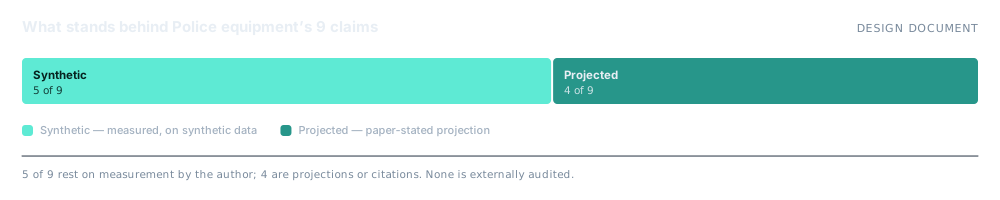
| Claim | Figure | Basis | Context |
|---|---|---|---|
| APES-L mass | 6.5 kg vs 20.25 kg incumbent | Synthetic | Simulation-derived, 23 spec simulations |
| APES-L panel service life | 10 years | Projected | Lifecycle model |
| APES-L ceramic tile replacement | 4 years | Projected | Lifecycle model |
| APES-L soft panel refresh | 6 years | Projected | Lifecycle model |
| Injury-score improvement | 66.2% | Synthetic | Modelled, against the incumbent system |
| Ten-year TCO saving | +$1.85 M per 500 officers | Projected | Procurement case, not an audited figure |
| Guardian LE cartridge | 4.6 × 22 mm DPAP, 396 m/s, 259 J | Synthetic | Against 501 m/s / 326 J for the military 4.6 × 30 mm |
| Guardian LE chamber pressure | 246 MPa | Synthetic | Simulator output |
| Guardian LE free recoil | 1.2 J | Synthetic | Momentum-conservation model |
Measured — author-run experiment on the stated setup. Synthetic — measured, but on synthetic rather than real data. Derived — follows from the stated construction or proof. Projected — paper-stated projection, not an author-run benchmark. Cited — taken from external literature.
How it works
- Shared portfolio physics. Both platforms verified through the same simulator and results file as the defence portfolio — no separate number source.
- Seven-phase lifecycle model. Recoil, structural safety factor, Archard bore wear, parts life and Monte Carlo reliability, per platform.
- V50 cross-check. Armour ballistic limit checked against the portfolio’s NIJ-calibrated model rather than asserted.
- Ten-year TCO framing. Procurement argued on lifecycle cost across a 500-officer force, not unit price.
What it does not do
Taken from the folder’s own README. Nothing here has been softened.
- Genre note from the folder: defence-research register, with no real procurement office or fielded materiel implied.
- Nothing has been manufactured or tested. All figures are simulation output.
- The 66.2% injury-score improvement is a modelled metric, not a clinical or field outcome.
- The $1.85 M ten-year saving depends on procurement, maintenance and replacement assumptions that no real force has validated.
- Two platforms is a narrow portfolio; the shared-physics discipline is inherited from the parent folder rather than established here.
Free under AGPL-3.0+ for almost everyone
Personal use, charities, education and organisations under AUD 50,000 a year pay nothing. A tiered commercial licence covers everyone else.