Research shelf / Materials & engineering / AusDike™
Written Updated
A flood barrier that gets stronger the deeper the water gets
A sealed flood barrier fights the full hydrostatic load. An open-bottom one lets the water in underneath, so the pressure equalises across both faces and the net lateral force drops by 73%. The panel gets its ballast from the thing it is holding back. The engineering question is then whether a 9 mm polypropylene wall can take the column load, and 28 simulations say yes with margin.
Specified in detail; implementation partial or absent.
An open-bottom self-ballasting levee panel taken from concept to tooling quote — 28 simulations, a buckling-governed wall, and one adverse finding the programme did not bury.
The panel is 600 × 300 × 560 mm, injection-moulded, ~15 kg empty — a two-person carry with no tools and no machinery. A 50 m run deploys in about ten minutes with two operators. The design intent is a domestically produced Australian competitor to imported steel and HDPE deployable barrier systems.
The engineering programme’s central finding is that the wall is column-buckling-governed rather than bending-governed. That changed the design: thickness went from 8 mm to 9 mm on the strength of analytical Euler and 20-element eigenvalue FEA agreeing to 0.0% error, and the polymer specification tightened from neat recycled polypropylene to 15% talc-filled rPP with HALS UV stabiliser, lifting heat-deflection temperature from 55 °C to 85 °C to cover Brisbane solar service.
At final spec the panel carries a 4.9× tipping safety factor and 2.1× sliding on a two-stack 600 mm flood with no bracing, anchors or flanges; column buckling is 15.7×; Miner’s-rule fatigue damage at 25 years is 0.00975, a 103× life margin. Costing is from first principles at A$65.51 per panel against a A$109/linear-metre target, with tooling breakeven at 3,500 panels.
Every number, and what stands behind it
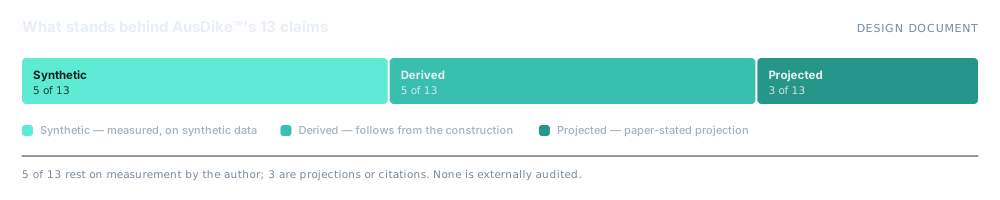
A claim is only worth the evidence attached to it. Each row below carries its basis: measured on the author’s own hardware, derived from the construction, measured on synthetic data, projected from literature, or simply cited.
| Claim | Figure | Basis | Context |
|---|---|---|---|
| Net lateral force reduction | 73% | Derived | Open-bottom self-ballasting vs a sealed cell |
| Empty panel mass | ~15 kg | Derived | Two-person carry, no tools |
| Deployment rate | 50 m in ~10 min, two operators | Projected | From panel handling time |
| Tipping safety factor | 4.9× | Synthetic | Two-stack 600 mm flood, no bracing or anchors |
| Sliding safety factor | 2.1× | Synthetic | Same load case |
| Column-buckling safety factor | 15.7× | Synthetic | Euler analytical and 20-element eigenvalue FEA agree to 0.0% |
| 25-year fatigue damage | 0.00975 (103× margin) | Synthetic | Miner’s rule |
| Heat-deflection temperature | 55 °C → 85 °C | Derived | 15% talc-filled rPP with HALS, for Brisbane solar service |
| First-principles COGS | A$65.51 per panel | Derived | Material, machine time, labour, 35% overhead |
| Price vs nearest competitor | 42% cheaper | Projected | A$109/m against Boxwall NZ at ~A$180/m |
| Tooling breakeven | 3,500 panels | Derived | Against A$382,500 advanced-tooling capex |
| Annual capacity, one machine | 59,750 panels (A$6.2 M) | Projected | 300-tonne machine, two shifts |
| Adverse finding — wind stability | empty two-stack fails above 35 m/s | Synthetic | Mandates a pre-fill-or-stake protocol |
Measured — author-run experiment on the stated setup. Synthetic — measured, but on synthetic rather than real data. Derived — follows from the stated construction or proof. Projected — paper-stated projection, not an author-run benchmark. Cited — taken from external literature.
How it works
- Open-bottom self-ballasting. Floodwater enters the panel base and equalises pressure across both faces — the barrier is ballasted by the flood.
- Dual-method buckling check. Analytical Euler and 20-element eigenvalue FEA, agreeing to 0.0% — which is what justified the 8 → 9 mm change.
- Four-SKU family. Standard, cold-climate, mine-chemical and 90° corner variants derived from the same simulation set.
- First-principles costing. COGS built from material, machine time, labour and overhead rather than quoted.
What it does not do
Taken from the folder’s own README. Nothing here has been softened.
- No physical prototype exists. The programme classifies itself as concept feasibility plus engineering-simulation closure, and nothing more.
- Empty two-stack panels lose tipping stability above 35 m/s wind. This is the programme’s own adverse finding and it constrains the deployment protocol.
- Polypropylene is incompatible with petroleum and hydraulic-oil bunding, which is why the mine SKU has to be HDPE.
- PP Izod impact halves at 0 °C, which is why the cold SKU has to be rubber-toughened rTPP.
- SES procurement cycles and NATA-laboratory AS/NZS certification are named as unresolved commercial risks.
Free under AGPL-3.0+ for almost everyone
Personal use, charities, education and organisations under AUD 50,000 a year pay nothing. A tiered commercial licence covers everyone else.