Research shelf / Materials & engineering / QDMP
Written Updated
A room-temperature quantum processor, and the seven reasons it doesn’t exist
CVD diamond synthesis is a mature industrial process. NV centres are real, work at room temperature, and are already used for sensing. The QDMP framework asks what would have to be true to get from there to a room-temperature quantum processor, and then spends most of its length on the seven reasons the answer is currently "a great deal".
Theory or design only. No in-house measurement.
Engineered NV-centre arrays in a metamaterial diamond lattice, proposed as a structured thought experiment — with seven named scientific barriers assessed against the current literature.
The proposal is engineered nitrogen-vacancy centre arrays embedded in a metamaterial diamond lattice, with electromagnetic fields during growth positioning the centres, microwave pathways for qubit control, and topological protection for the logical states. The claimed target regime is coherence beyond 100 seconds at room temperature, against milliseconds today, at a qubit density of 1014 per cubic centimetre.
The paper positions itself as a structured thought experiment rather than a device proposal. Its value is in the second half: seven fundamental scientific barriers are identified, each assessed against the current literature, with a targeted research programme proposed for each. Among them, the inability to position NV centres with nanometre precision and the fundamental decoherence mechanisms that currently cap coherence times.
A companion paper covers the industrial reality — CVD production throughput, isotopic purification, AI-assisted growth optimisation — and reads as a technology review and strategic assessment of what near-term diamond quantum applications actually look like, which is sensing rather than computing.
Every number, and what stands behind it
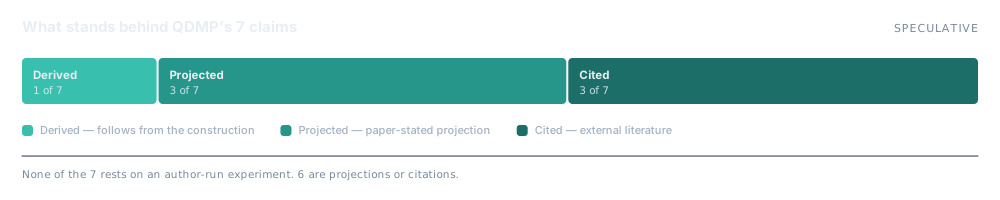
A claim is only worth the evidence attached to it. Each row below carries its basis: measured on the author’s own hardware, derived from the construction, measured on synthetic data, projected from literature, or simply cited.
| Claim | Figure | Basis | Context |
|---|---|---|---|
| Target coherence time | 100+ seconds | Projected | Against milliseconds in current NV technology |
| Current NV coherence | milliseconds | Cited | Room temperature, present-day devices |
| Target qubit density | 10¹⁴ per cm³ | Projected | Design target, not demonstrated |
| Logical qubits targeted | 1 million | Projected | From 1 billion physical, with topological protection |
| Scientific barriers identified | 7 | Derived | Each assessed against current literature |
| NV positioning precision | not currently achievable at nm scale | Cited | Named as barrier — the honest half of the paper |
| Near-term realistic application | quantum sensing | Cited | From the companion technology review |
Measured — author-run experiment on the stated setup. Synthetic — measured, but on synthetic rather than real data. Derived — follows from the stated construction or proof. Projected — paper-stated projection, not an author-run benchmark. Cited — taken from external literature.
How it works
- Metamaterial lattice engineering. Diamond structured so the lattice itself participates in protecting the quantum states.
- In-situ defect engineering. Electromagnetic fields during CVD growth positioning NV centres, rather than implanting them afterwards.
- Topological protection. Logical states protected by structure rather than by cryogenic isolation.
- Barrier-first assessment. Seven blockers named and evaluated against literature, with a research programme proposed for each.
What it does not do
Taken from the folder’s own README. Nothing here has been softened.
- Explicitly speculative. The paper calls itself a thought experiment and does not claim a device is near.
- The coherence target is five orders of magnitude beyond current room-temperature NV performance.
- Nanometre-precision NV placement, the enabling capability for the whole architecture, does not exist.
- Topological qubit protection in diamond is proposed by analogy to other platforms, not demonstrated.
- No fabrication, no measurement, no device.
Free under AGPL-3.0+ for almost everyone
Personal use, charities, education and organisations under AUD 50,000 a year pay nothing. A tiered commercial licence covers everyone else.