A decompiler that recovers the algorithm, not just the code
Organisations often need to understand software they have no source code for: an old system, a bought-in component, something that arrived and looks suspicious. Tools already exist that turn the machine code back into readable steps. RetDec Imortek tries to go one further and name what those steps are — this part is the Advanced Encryption Standard (AES), this part is a sort, this part is how the data is packed for sending.
Upstream RetDec v5.0 has been inactive since 2022. It remains one of the few open decompilers with a genuinely broad front end — and that breadth is worth keeping alive.
What this is, in one minute
Software ships as something a machine reads and a person cannot. When there is no source code — the supplier is gone, the contract never included it, the file arrived from somewhere you do not trust — nobody can say what the program actually does. Checking it by hand means reading machine instructions one at a time.
It takes the compiled file apart and rebuilds C from it: all 216 binaries in the test corpus come back as buildable C. Then it goes after the meaning — which cryptography, which sort, which threading, which file format — and reports how often that works, including the case where it barely does.
Security teams taking malware apart, who need the answer before they need the code. Companies running software nobody has the source for, who need a description of it before anything can safely be rebuilt or replaced. Anyone stuck with a file format that was never documented — old records, a machine that will only talk to its own software.
The actual decoder, compiled to WebAssembly
Everything above this is a scripted walk through the abstraction ladder. This is the first rung running for real: Capstone — the same disassembler the native RetDec build links — decoding bytes you paste in.
capstone — WebAssembly
791 kilobytes (KB) because a real x86 decoder carries the whole instruction set — every encoding, prefix and extension. That is the honest size of the thing.
deps/capstone.
Native, bytecode and emerging formats
Output is format-dependent, because pretending everything decompiles to C helps nobody. The front end takes native binaries in Executable and Linkable Format (ELF), Portable Executable (PE) and Mach-O; bytecode, including Java Virtual Machine (JVM) class files, Dalvik Executable (DEX) and Common Intermediate Language (CIL); and newer targets such as CUDA’s Parallel Thread Execution (PTX).
ELF · PE · Mach-O
Produces C pseudocode, plus the semantic layer that is the point of the fork.
Python · Lua · JVM · DEX · CIL
Python and Lua bytecode return their own languages; managed code paths emit Java-family or C#-family output.
WebAssembly · CUDA PTX
WebAssembly converts to WebAssembly Text format (WAT). PTX is handled as a first-class input rather than an afterthought.
Watch a function climb the abstraction ladder
Pick a binary function and step it through the pipeline: raw bytes, disassembly, lifted IR, C pseudocode, and finally the semantic verdict — the named algorithm, with the evidence that identified it.
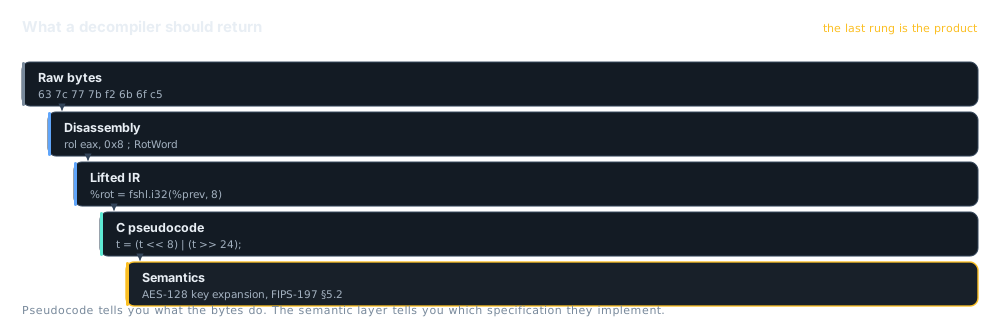
retdec — specification extraction
Semantic verdict
Evidence
With symbols stripped, recovery must work from structure alone — constants, round counts, control-flow shape. That is the hard case, and the one the measured F1 of 0.056 refers to.
Six families of structure
Standard Template Library (STL) containers and C++ runtime structures — the shape of a std::vector reappearing from the allocation pattern.
AES, the Secure Hash Algorithm (SHA) family, ChaCha20, Rivest–Shamir–Adleman (RSA) and elliptic curve primitives, identified by constants and round structure.
Introsort, merge sort, binary search — including the depth-limit switch that gives introsort away.
Graph algorithms, plus Breadth-First Search (BFS) and Depth-First Search (DFS) traversal patterns.
std::thread, pthreads, OpenMP, Threading Building Blocks (TBB) and raw atomics.
Protobuf, FlatBuffers, MessagePack, JavaScript Object Notation (JSON) and Extensible Markup Language (XML) framing.
216 binaries, and the number that hurts
All 216 ELF binaries in the test corpus produce buildable C with
--buildable, which is on by default. Algorithm recovery is a different
story, and the honest way to report it is both numbers side by side.
| Metric | Result | Condition |
|---|---|---|
| Buildable C output | 216 / 216 | --buildable, default on |
| Algorithm recovery F1 | 0.056 | Name-blind, 95% confidence interval 0.034–0.083 |
| Algorithm recovery F1 | 1.000 | Name-assisted, symbolicated binaries |
Default .c recompiles | No | Neither this fork nor stock RetDec |
Optional, offline, and gated
Refinement runs through llama.cpp with GGUF models, entirely offline, only when
RETDEC_NEURAL_REFINE=1 and a model path is supplied. It is off by default
and it never replaces the baseline.
- Compile gate. Refined output must pass
gcc -fsyntax-onlybefore it is accepted. - Structural validation. The refinement must still correspond to the lifted structure.
- Deterministic baseline preserved. The unrefined decompiler output remains the auditable artefact. If you need to defend a finding, you defend that one.
- No network. Local GGUF inference. Nothing about your binary leaves the machine.
$ export RETDEC_NEURAL_REFINE=1
$ export RETDEC_NEURAL_MODEL=/models/qwen-coder.gguf
$ retdec-decompiler --buildable ./target.elf
Works out what a program does when the source code is gone
Software ships as something a machine can read and a person cannot. This takes that back apart and tells you, in plain terms, what the program is actually doing.
Security teams pulling malware apart
Instead of pages of unreadable code, you get the answer: this part is scrambling data, this part is how it calls home, this part is how it hides. That is the bit an analyst needs first.
Companies with old software and no source code
The system still runs the business, and whoever wrote it left years ago. This recovers a description of what it does, which is what you need before anyone can safely rebuild or replace it.
Anyone stuck with a file format nobody documented
Old records, a machine that will only talk to its own software, a competitor's export file. This works out the structure so your own software can read it.
Qt 6 Graphical User Interface (GUI), or no GUI at all
Synchronised code views across C, assembly, IR and control-flow graphs, with function navigation, string inspection, a binary browser and an assistant panel. Headless mode drops every GUI dependency so the same build runs in Continuous Integration (CI).
The GNU Affero General Public License (AGPL-3.0+) for open-source use, or a commercial licence for proprietary deployment. Copyright Odin Loch, trading as Imortek, 2025–2026.
Shippable at v2.0.21. CI gates reflect development rather than production maturity standards — stated by the project, not inferred.