Research shelf / Biology & medicine / NQD
Written Updated
Neural interfacing with injectable nanodiamonds and ultrasound-powered motes
The original neural-dust proposal put ultrasound-powered motes in tissue to avoid transcranial wiring. This architecture adds a second tier below it: fluorescent nanodiamonds bearing nitrogen-vacancy centres, injectable intravenously, sitting close enough to individual neurons to do quantum magnetometry on them — with the motes acting as the optical readout layer rather than the sensor.
Theory or design only. No in-house measurement.
Quantum nanodiamond sensors at single-neuron proximity, read optically by ultrasound-powered CMOS motes that backscatter to a wearable array — no wires through the skull.
Tier 1 is the Quantum Nanodiamond sensor: 150–250 nm fluorescent nanodiamonds carrying NV centres, surface-functionalised for neuronal attachment and small enough to inject intravenously. NV centres give magnetometry, thermometry, electric-field sensing and nuclear-spin memory at room temperature, which is what makes single-neuron proximity sensing conceivable without cryogenics.
Tier 2 is the Acoustic Processing and Exchange mote: 80–150 µm aluminium-nitride and 65 nm CMOS hybrid devices on parylene-C flexible substrates. Each harvests power piezoelectrically from ultrasound, optically interrogates the nanodiamonds around it, processes locally, can stimulate tissue, and communicates back by acoustic backscatter to an external wearable transceiver array.
Together the two tiers form a distributed quantum–classical mesh covering large tissue volumes with no transcranial wires and no large implant, and with a graceful degradation model — individual sensors and motes failing degrades resolution rather than killing the interface. The document develops the mathematical framework, fabrication specifications, deployment protocols, an operating-system model and a clinical roadmap.
Every number, and what stands behind it
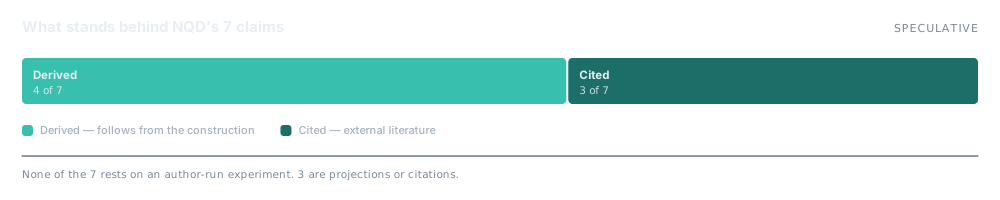
A claim is only worth the evidence attached to it. Each row below carries its basis: measured on the author’s own hardware, derived from the construction, measured on synthetic data, projected from literature, or simply cited.
| Claim | Figure | Basis | Context |
|---|---|---|---|
| QND sensor size | 150–250 nm | Derived | Fluorescent nanodiamond with NV centres, IV-injectable |
| APEX mote size | 80–150 µm | Derived | AlN piezo + 65 nm CMOS on parylene-C |
| Sensing modalities | magnetometry, thermometry, E-field, nuclear spin memory | Cited | Established NV-centre capabilities |
| Power delivery | piezoelectric ultrasound harvesting | Cited | The original neural-dust mechanism |
| Uplink | acoustic backscatter | Cited | To an external wearable transceiver array |
| Architecture tiers | 2 | Derived | Quantum sensing below, classical processing above |
| Transcranial wiring required | none | Derived | The central architectural claim |
Measured — author-run experiment on the stated setup. Synthetic — measured, but on synthetic rather than real data. Derived — follows from the stated construction or proof. Projected — paper-stated projection, not an author-run benchmark. Cited — taken from external literature.
How it works
- NV-centre quantum sensing. Room-temperature magnetometry and thermometry from nitrogen-vacancy defects — the reason diamond is the sensor material.
- Surface functionalisation for neuronal attachment. Chemistry that puts the sensor where the signal is rather than nearby.
- Piezoelectric ultrasound harvesting. Power in without wires, at a depth ultrasound can reach.
- Acoustic backscatter uplink. Data out by modulating reflection rather than transmitting — the mote never needs a radio.
What it does not do
Taken from the folder’s own README. Nothing here has been softened.
- Speculative throughout. No device has been fabricated and no in-vivo work is reported.
- IV-injectable nanodiamonds crossing the blood-brain barrier and attaching selectively to neurons is assumed, not demonstrated.
- Optical interrogation of nanodiamonds through brain tissue at useful depth is the hardest unsolved step and is treated as an engineering parameter.
- Biocompatibility, clearance and long-term retention of both tiers are unaddressed at the level a clinical roadmap would require.
- The clinical application roadmap is aspirational; nothing here is close to a regulatory pathway.
Free under AGPL-3.0+ for almost everyone
Personal use, charities, education and organisations under AUD 50,000 a year pay nothing. A tiered commercial licence covers everyone else.