Research shelf / Chemistry & products / Depot delivery
Written Updated
Real depot-delivery engineering, and openly fictional compounds to put in it
This folder has two halves and refuses to blur them. One is a technically serious treatment of injectable depot delivery as a systems-engineering problem: release kinetics, polymer matrices, burst management, excipient selection. The other is a set of invented therapeutic compounds, labelled as invented at the top of every file. The README’s stated job is to route readers between the two without eliding the boundary.
Theory or design only. No in-house measurement.
A genuine pharmaceutics playbook — PLGA tuning bands, phase-inversion gels, Higuchi release kinetics, ICH Q8 framing — paired with invented compounds that the folder banner-flags as fiction on every page.
The Universal Depot Systems paper is the substantial part. It classifies release by mechanism — dissolution, diffusion, degradation, osmotic — and tabulates PLGA tuning bands against target duration: 50:50 at 10–25 kDa for one to three months, 85:15 at 80–150 kDa for six to twelve, PLA at 100–300 kDa for twelve to thirty-six month ultra-long implants. It covers NMP-based in-situ-forming depots via phase inversion, Poloxamer F127 thermoreversible gels, and Higuchi √t mixed diffusion–erosion with the characteristic triphasic burst–lag–terminal profile, all framed against Quality-by-Design and ICH Q8.
A companion review compares sugar-based injectable excipients by solubility — mannitol at roughly 182 mg/mL, trehalose 689, glucose 909, sucrose 2000 — and emphasises reducing-sugar Maillard risk when the payload is a protein. That is ordinary, useful formulation science and it is the reason the folder is worth reading at all.
The other half is explicitly creative. The Nootropics/ and Schizophrenia Cure/ monographs describe invented compounds with chemical structures, mechanism notes and projected pharmacokinetics, anchored where possible to real referents — COGNIMAX-PRO is written against the September 2024 FDA approval of xanomeline–trospium, and NeuroBridge-7’s mechanism is framed by analogy to a published GluN2B allosteric modulator. Every invented compound is banner-flagged. None has been validated in any preclinical or clinical setting.
Every number, and what stands behind it
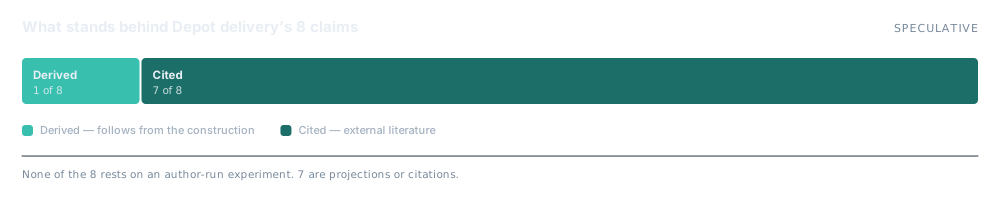
A claim is only worth the evidence attached to it. Each row below carries its basis: measured on the author’s own hardware, derived from the construction, measured on synthetic data, projected from literature, or simply cited.
| Claim | Figure | Basis | Context |
|---|---|---|---|
| PLGA 50:50, 10–25 kDa | 1–3 month release | Cited | Standard formulation tuning band |
| PLGA 85:15, 80–150 kDa | 6–12+ month release | Cited | Standard formulation tuning band |
| PLA 100–300 kDa | 12–36 month implants | Cited | Ultra-long-acting regime |
| Release kinetics model | Higuchi √t, triphasic | Cited | Mixed diffusion–erosion: burst, lag, terminal |
| Excipient solubility — mannitol | ~182 mg/mL | Cited | Comparative excipient review |
| Excipient solubility — trehalose / sucrose | ~689 / ~2000 mg/mL | Cited | Same review; Maillard risk flagged for proteins |
| Regulatory framing | QbD / ICH Q8 | Cited | The framework the depot paper works within |
| Speculative compounds | clinically unvalidated | Derived | Zero preclinical or clinical data, by the folder’s own statement |
Measured — author-run experiment on the stated setup. Synthetic — measured, but on synthetic rather than real data. Derived — follows from the stated construction or proof. Projected — paper-stated projection, not an author-run benchmark. Cited — taken from external literature.
How it works
- Mechanism-first release classification. Dissolution, diffusion, degradation and osmotic mechanisms treated separately rather than fitted to one curve.
- Polymer molecular-weight tuning. Duration selected by copolymer ratio and molecular weight rather than by dose.
- In-situ-forming depots. NMP phase-inversion and thermoreversible poloxamer systems as alternatives to preformed microspheres.
- Explicit fiction banners. Every invented compound carries a disclaimer at the top of its file — the boundary is maintained in the documents, not just the index.
What it does not do
Taken from the folder’s own README. Nothing here has been softened.
- The folder’s own disclaimer: all compound content is fiction or speculative formulation work, not medical, legal or tactical advice.
- None of the described compounds has been validated in any preclinical or clinical setting. Several would fall under controlled-substance frameworks if they were real.
- Do not synthesise, possess or administer anything described in this folder.
- The depot-delivery framework is a synthesis of published pharmaceutics. It is a teaching reference for the general mechanics, not novel research.
- Projected pharmacokinetics for invented compounds are projections about molecules that do not exist.
Free under AGPL-3.0+ for almost everyone
Personal use, charities, education and organisations under AUD 50,000 a year pay nothing. A tiered commercial licence covers everyone else.