Research shelf / Materials & engineering / UCDW
Written Updated
Diffusion welding without the vacuum chamber
Vacuum diffusion welding gives you joints at 95–98% of parent metal strength and asks for a half-million-dollar chamber and hours at temperature. UCDW proposes reaching the same window at roughly half the temperature with no vacuum at all, by stacking three independent bonding mechanisms inside a chemically active ionic liquid instead of relying on heat alone.
Specified in detail; implementation partial or absent.
Electrochemical ion migration, thermal diffusion and ultrasonic assistance combined in an ionic-liquid substrate, spanning 77% to 99% of parent-metal strength across five operating regimes.
Three mechanisms run simultaneously rather than sequentially: electrochemical ion migration through the ionic-liquid substrate, thermally activated solid-state diffusion across the interface, and ultrasonic acoustic assistance disrupting the oxide layer that normally blocks metal-to-metal contact. Each is a known process; the claim is that together their activation energies compound.
The paper defines five discrete operating regimes, each with a linear strength–time model and characterised microstructure. ULTRA-FLASH at 150 °C for two minutes is claimed to exceed conventional TIG/MIG fusion welding (72.5% of base metal). ULTRA-PRECISION at 250–300 °C for 30–60 minutes targets the 95–98% band that vacuum diffusion welding occupies.
Two substrate formulations are specified with mass-fraction tables, characterised by ionic activation energy of 20 kJ/mol and thermal diffusion energies reduced 30–45% relative to unassisted solid-state bonding. The economic argument is the sharpest part: $8,000–$50,000 of equipment against $500,000–$2,000,000 for a vacuum diffusion system, which is what makes portable field deployment conceivable at all.
Every number, and what stands behind it
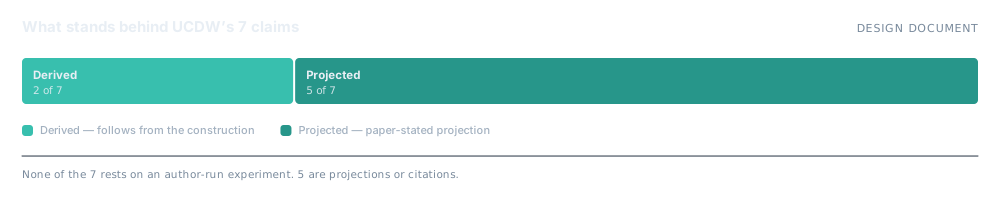
A claim is only worth the evidence attached to it. Each row below carries its basis: measured on the author’s own hardware, derived from the construction, measured on synthetic data, projected from literature, or simply cited.
| Claim | Figure | Basis | Context |
|---|---|---|---|
| Strength range across regimes | 77% – 99% of parent metal | Projected | Five regimes, linear strength–time models |
| ULTRA-FLASH regime | 150 °C, 2 min, >72.5% | Projected | Compared against conventional TIG/MIG fusion |
| ULTRA-PRECISION regime | 250–300 °C, 30–60 min, 95–98% | Projected | The vacuum-diffusion-welding band, at half the temperature |
| Ionic activation energy | 20 kJ/mol | Derived | Substrate formulation characteristic |
| Thermal diffusion energy reduction | 30–45% | Projected | Relative to unassisted solid-state bonding |
| Equipment capital cost | $8,000 – $50,000 | Projected | Against $500,000 – $2,000,000 for vacuum diffusion |
| Operating regimes specified | 5 | Derived | Each with strength–time model and microstructural characterisation |
Measured — author-run experiment on the stated setup. Synthetic — measured, but on synthetic rather than real data. Derived — follows from the stated construction or proof. Projected — paper-stated projection, not an author-run benchmark. Cited — taken from external literature.
How it works
- Ionic-liquid substrate. Chemically active medium carrying the electrochemical migration, with two formulations specified by mass fraction.
- Gallium wetting. Surface preparation that lowers the barrier to metal-to-metal contact.
- Ultrasonic oxide disruption. Acoustic assistance breaking the oxide film that otherwise dominates the interface resistance.
- Regime taxonomy. Five named operating points spanning field-expedient repair to certified aerospace structural joints.
What it does not do
Taken from the folder’s own README. Nothing here has been softened.
- Every strength figure is a model projection from the linear strength–time relationships, not a measured coupon test. No physical joints reported.
- The three-mechanism synergy is the central claim and the least verified: the paper assumes activation energies compound rather than interfere.
- Ionic liquids in a field-repair context bring handling, disposal and shelf-life problems the paper does not cost.
- Aerospace structural certification is named as an application. Nothing here approaches a certification basis.
- Comparison to vacuum diffusion welding is against literature values, not against a side-by-side trial.
Free under AGPL-3.0+ for almost everyone
Personal use, charities, education and organisations under AUD 50,000 a year pay nothing. A tiered commercial licence covers everyone else.