Research shelf / Materials & engineering / HX-70 GradePlex
Written Updated
Carbide tooling for HRC 40–70, where WC-Co gives out and CBN is too narrow
Conventional WC-Co inserts fail around HRC 55. CBN inserts work above that but exist only in limited geometries. This is a three-part tooling system aimed squarely at the gap — written by a working toolmaker, with the performance figures labelled as projections rather than benchmarks.
Specified in detail; implementation partial or absent.
A functionally-graded carbide substrate, a five-layer coating stack, and a forge-to-machine supply chain — targeting the gap between where conventional inserts fail and where CBN geometries exist.
The HX-70 GradePlex substrate puts three functionally-graded zones in a single sintered billet: a hard, fine-grained working surface at 92.5% WC, 5.5% Co and 2.0% TaC/NbC inhibitors, reaching 2050–2100 HV30, over a tougher 13% Co core. It is achieved by controlled powder layering and HIP densification rather than by joining separate pieces.
The TriboshieldPlus coating is a five-layer stack: a CrN bond layer, an AlCrN thermal barrier, an nc-AlTiSiN/a-Si₃N₄ hardness core at 42–46 GPa, a 40-bilayer AlCrN/AlTiSiN superlattice, and a DLC-Si friction layer below µ = 0.15.
The forge-to-machine supply chain is the commercial half. Near-net-shape forging reduces the volume that has to be machined; the H13-breech exemplar shows a 40–45% cost reduction (AUD 190–240 against 340–420) and a 65–70% lead-time reduction (6–9 against 18–26 working days).
Every number, and what stands behind it
A claim is only worth the evidence attached to it. Each row below carries its basis: measured on the author’s own hardware, derived from the construction, measured on synthetic data, projected from literature, or simply cited.
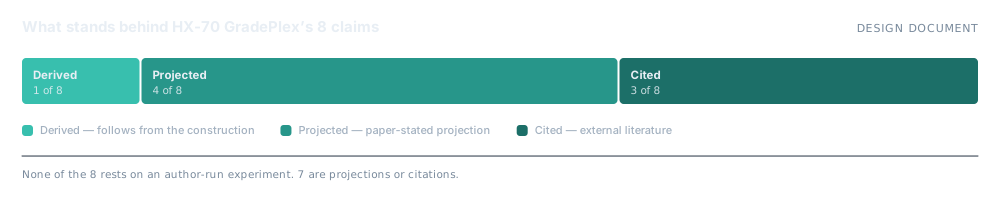
| Claim | Figure | Basis | Context |
|---|---|---|---|
| Working-surface hardness | 2050–2100 HV30 | Cited | 92.5% WC / 5.5% Co / 2.0% TaC-NbC |
| Core toughness | 13% Co | Derived | Graded in one sintered billet |
| Coating hardness core | 42–46 GPa | Cited | nc-AlTiSiN/a-Si₃N₄ |
| Friction coefficient | µ < 0.15 | Cited | DLC-Si outer layer |
| Tool life, HRC 55–60 | 40–100% gain vs premium AlTiN | Projected | Paper-stated projection |
| Cost advantage over CBN, HRC 65–70 | 60–70% | Projected | Paper-stated projection |
| Exemplar cost reduction | 40–45% (AUD 190–240 vs 340–420) | Projected | H13 breech, forge-to-machine |
| Exemplar lead-time reduction | 65–70% (6–9 vs 18–26 days) | Projected | H13 breech |
Measured — author-run experiment on the stated setup. Synthetic — measured, but on synthetic rather than real data. Derived — follows from the stated construction or proof. Projected — paper-stated projection, not an author-run benchmark. Cited — taken from external literature.
How it works
- Controlled powder layering. Three graded zones formed in one billet before sintering.
- HIP densification. Hot isostatic pressing to close residual porosity.
- Five-layer PVD stack. Bond, thermal barrier, hardness core, superlattice, friction layer.
- Near-net-shape forging. Reduces the volume of material that must be removed by machining.
What it does not do
Taken from the folder’s own README. Nothing here has been softened.
- Author-run machining benchmarks are unconfirmed — treat every performance gain as a paper-stated projection.
- Sintering tolerances are strict: carbon ±0.02 wt%, dew point ≤ −60°C, demanding specialised furnace control.
- Documentation is heavily cited from peer-reviewed metallurgy, but the system as a whole has not been built and tested end to end.
Free under AGPL-3.0+ for almost everyone
Personal use, charities, education and organisations under AUD 50,000 a year pay nothing. A tiered commercial licence covers everyone else.