Research shelf / Biology & medicine / HSA
Written Updated
A human-enhancement protocol that publishes its own 20–32% harm estimate
Most human-enhancement writing is either dismissive or credulous. This protocol is neither: it sequences AAV and lentiviral delivery, CRISPR base and prime editing, cyclical partial reprogramming, senolytics and organ bioprinting across 24 to 34 months, and then publishes a risk table putting cumulative serious-adverse-event probability at 20 to 32 percent. The number is the most honest thing in it.
Theory or design only. No in-house measurement.
A three-phase genetic-modification programme written as engineering speculation, with tiered evidentiary disclaimers, a cumulative adverse-event table, and an opening banner declaring it theoretical and worldbuilding only.
Phase I is foundational over roughly six months: whole-genome sequencing, epigenetic baseline mapping, and targeted CRISPRa/CRISPRi interventions across mitochondrial, NAD+, antioxidant, immune, hormonal, bone and neural axes. Phase II runs eight to ten months on the longevity core — inducible OSK partial reprogramming (deliberately without c-Myc), multi-mechanism senolytic clearance, conditional TERT activation, Klotho and GDF11 modules, targeted bioprinting, and mTORC1 modulation. Phase III spends ten to fourteen months on sensory, physical, neural and environmental-resilience expansion.
What distinguishes it from the genre is the evidentiary tiering. Modules are graded, and Tier 4 modules openly state that mammalian validation is missing. Real anchors are cited as real — the PEARL rapamycin trial, UAB’s Klotho AAV9 lifespan work, the documented CCR5 Δ32 patient series — and aspirational targets are tabulated as aspirational, with capability figures given as ranges rather than points.
The protocol also specifies what happens when it goes wrong: cytokine-storm IL-6 thresholds, an oncologic kill-switch design, PMP22 over-myelination mitigation, reversibility architectures and a lifelong maintenance schedule. That is the structure of a document that expects failure modes rather than one that markets outcomes. Its own banner reads: speculative research document, for theoretical and worldbuilding purposes only.
Every number, and what stands behind it
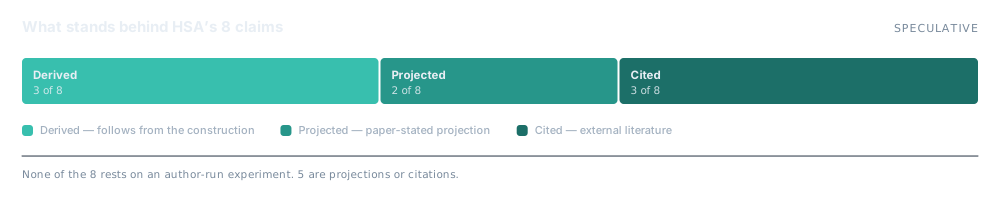
A claim is only worth the evidence attached to it. Each row below carries its basis: measured on the author’s own hardware, derived from the construction, measured on synthetic data, projected from literature, or simply cited.
| Claim | Figure | Basis | Context |
|---|---|---|---|
| Cumulative serious adverse event probability | 20–32% | Projected | Author’s own risk table, across all three phases |
| Programme duration | 24–34 months active intervention | Derived | Three sequential phases |
| Capability domains addressed | 10 | Derived | Mitochondrial through environmental tolerance |
| Evidentiary tiering | Tier 4 admits no mammalian validation | Derived | The grading is published with the modules |
| PEARL rapamycin trial | cited as real anchor | Cited | Real trial, real result, cited as such |
| UAB Klotho AAV9 | 19.7% male-mouse lifespan extension | Cited | Published pre-clinical result |
| CCR5 Δ32 pathway | Berlin / London / Düsseldorf / Geneva series | Cited | Documented patient cases |
| Epigenetic age target | −3 to −15 years | Projected | Via OSK cycling — aspirational, not demonstrated in humans |
Measured — author-run experiment on the stated setup. Synthetic — measured, but on synthetic rather than real data. Derived — follows from the stated construction or proof. Projected — paper-stated projection, not an author-run benchmark. Cited — taken from external literature.
How it works
- Sequenced three-phase structure. Foundations, then longevity core, then expansion — ordered so later modules depend on earlier baselines.
- OSK cyclical partial reprogramming. Yamanaka factors without c-Myc, cycled rather than sustained, following the published partial-reprogramming literature.
- Tiered evidentiary disclosure. Each module graded by how much validation exists behind it, with the weakest tier stating outright that mammalian data is absent.
- Emergency and reversibility architecture. Cytokine-storm thresholds, kill-switch design and reversal paths specified alongside the interventions.
What it does not do
Taken from the folder’s own README. Nothing here has been softened.
- The protocol’s own opening banner: speculative research document, for theoretical and worldbuilding purposes only. It is not a clinical pathway.
- A cumulative serious-adverse-event probability of 20–32% is, by any clinical standard, disqualifying. The document publishes it rather than hiding it.
- Tier 4 modules have no mammalian validation at all, by the author’s own grading.
- Capability targets — muscle +60–90%, VO₂ +35–50%, radiation resistance 5–15× — are aspirational tabulations, not results.
- Nothing here has ethical approval, regulatory standing, or a route to either. Germline and somatic enhancement of this kind is prohibited in most jurisdictions.
Free under AGPL-3.0+ for almost everyone
Personal use, charities, education and organisations under AUD 50,000 a year pay nothing. A tiered commercial licence covers everyone else.