Research shelf / Chemistry & products / Hemp Harmony
Written Updated
A body lotion formulated the way a paper would argue it
Cosmetic formulation documents usually work backwards from marketing copy. This one works forwards from evidence: a lipid phase, a water phase and an active phase, each ingredient tied to a mechanism and each mechanism tied to a citation, across five dermatological axes.
Specified in detail; implementation partial or absent.
A three-phase botanical cosmeceutical with every ingredient class substantiated from peer-reviewed clinical, in-vitro and ethnobotanical evidence rather than asserted.
The lipid phase is dominated by hemp seed oil in combination with prickly pear, sea buckthorn and baobab oils. The water phase carries Tremella and snow-mushroom polysaccharides as humectants in place of synthetic ones. The active phase concentrates Centella asiatica, hibiscus, horsetail and rosehip seed oil.
The document’s method is to substantiate each ingredient class separately — peer-reviewed clinical data where it exists, in-vitro data where it does not, ethnobotanical evidence where neither does — and to be explicit about which of the three is doing the work in each case. That distinction is the difference between a formulation rationale and a claim sheet.
The five axes it argues across are trans-epidermal hydration, barrier reinforcement, collagen and elastin synthesis, anti-inflammatory cytokine modulation, and antioxidant free-radical scavenging — with the natural preservation system, fragrance rationale and sustainability credentials treated as formulation decisions rather than afterthoughts.
Every number, and what stands behind it
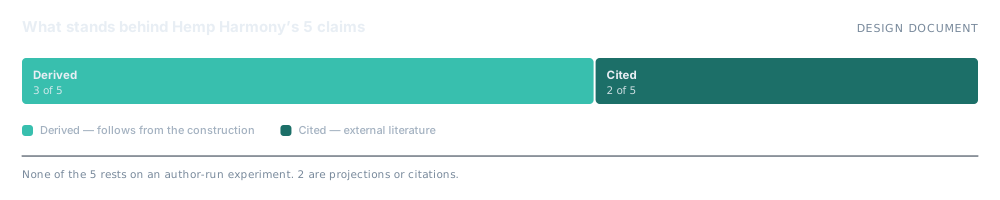
A claim is only worth the evidence attached to it. Each row below carries its basis: measured on the author’s own hardware, derived from the construction, measured on synthetic data, projected from literature, or simply cited.
| Claim | Figure | Basis | Context |
|---|---|---|---|
| Formulation phases | 3 (lipid, water, active) | Derived | Standard emulsion architecture, specified by phase |
| Dermatological axes argued | 5 | Derived | Hydration, barrier, collagen/elastin, anti-inflammatory, antioxidant |
| Evidence basis per ingredient class | clinical, in-vitro or ethnobotanical | Cited | Stated explicitly for each — the document’s main discipline |
| Humectant strategy | Tremella / snow mushroom polysaccharides | Cited | In place of synthetic humectants |
| Preservation | natural system | Derived | Reviewed alongside fragrance and sustainability |
Measured — author-run experiment on the stated setup. Synthetic — measured, but on synthetic rather than real data. Derived — follows from the stated construction or proof. Projected — paper-stated projection, not an author-run benchmark. Cited — taken from external literature.
How it works
- Phase-separated formulation. Lipid, water and active phases specified independently so each ingredient’s role is unambiguous.
- Graded evidence substantiation. Clinical, in-vitro and ethnobotanical evidence distinguished rather than merged into one claim.
- Mechanism-per-axis argument. Each of the five dermatological axes argued from a stated mechanism, not from an ingredient list.
- Preservation and sustainability as design. Treated as formulation constraints alongside efficacy rather than as labelling.
What it does not do
Taken from the folder’s own README. Nothing here has been softened.
- No product has been manufactured, stability-tested or challenge-tested.
- Ingredient-level evidence is not product-level evidence. Substantiating each component does not substantiate the formulation.
- Natural preservation systems are the hardest part of a botanical formulation, and no challenge test is reported.
- Cosmetic efficacy claims are regulated in most jurisdictions; nothing here has been assessed against those requirements.
- No consumer testing, no dermatological trial, no shelf-life data.
Free under AGPL-3.0+ for almost everyone
Personal use, charities, education and organisations under AUD 50,000 a year pay nothing. A tiered commercial licence covers everyone else.