Research shelf / Chemistry & products / Bar operations
Written Updated
A bar documented the way an engineer documents a factory
Recipe content tells you what to mix. The documentation that actually keeps a bar running looks nothing like it: infusion timings, batch ratios, prep rhythms, quality checkpoints and a platform abstraction that lets a seasonal menu change without re-deriving everything underneath it. This folder is that second kind of document.
Code exists and runs. Performance not independently checked.
Four native-botanical bases driving every infusion, syrup and bitters on the menu, with explicit timings, batch ratios, QC checkpoints and shift rhythms.
The platform is four Australian native-botanical bases — Coastal, Bush Orchard, Outback Heat, Native Forest — from which every spirit infusion, syrup, tincture and bitters derives. Above them sit four signature series of three drinks each, with a zero-proof mirror per series, so a seasonal rework changes the finished goods without disturbing the intermediates.
Timings and ratios are specified rather than implied: Coastal Gin infuses 48 hours, Bush Vodka 24, Spiced Rum 72; Native Orgeat is a three-day process; syrups are 1:1 by default with Spiced Forest at 2:1 Demerara; garnish dehydration runs at 57 °C for 12 hours. The prep workflow is organised by shift, day, week and month, with an explicit QC checkpoint — taste all syrups daily — and weekend essential-prep-only rules.
Two complete bitters fabrication specs run in parallel, a 500 ml template and a 375 ml alternative on a 21-day simplified timeline, both with phased infusion (primary days 1–10, aromatics 11–17, finishing 18+) at ≥60% ABV with water dilution to land the tincture strength. A separate umami, marine and ferment lane specifies 2-hour mushroom stock, 4-hour fat-wash protocols, a salmon-oil cap of three drops per drink, and 24-hour cold dashi with a 48-hour use window.
Every number, and what stands behind it
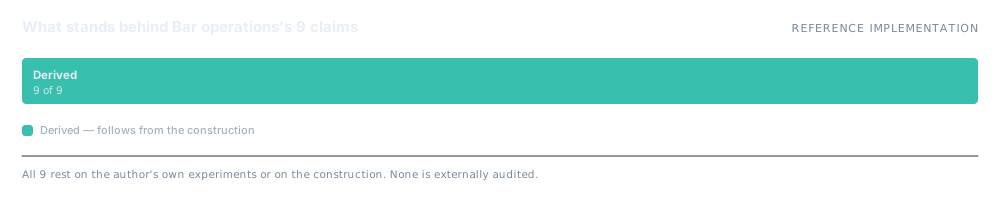
A claim is only worth the evidence attached to it. Each row below carries its basis: measured on the author’s own hardware, derived from the construction, measured on synthetic data, projected from literature, or simply cited.
| Claim | Figure | Basis | Context |
|---|---|---|---|
| Botanical bases | 4 | Derived | Coastal, Bush Orchard, Outback Heat, Native Forest |
| Menu structure | 4 series × 3 drinks + zero-proof mirrors | Derived | Seasonal scaling applies to finished goods only |
| Infusion timings | gin 48 h, vodka 24 h, rum 72 h | Derived | Specified, not approximate |
| Syrup ratios | 1:1 default; 2:1 Demerara for Spiced Forest | Derived | Batch specification |
| Garnish dehydration | 57 °C / 12 h | Derived | Aus-citrus system |
| Bitters templates | 500 ml and 375 ml (21-day) | Derived | Phased: primary 1–10, aromatics 11–17, finishing 18+ |
| Bitters spirit strength | ≥ 60% ABV, then water-diluted | Derived | To land tincture strength |
| Umami protocols | 2 h stock, 4 h fat-wash, 24 h cold dashi (48 h use) | Derived | With a ≤ 3 drops/drink salmon-oil cap |
| QC checkpoint | taste all syrups daily | Derived | The one non-negotiable in the prep workflow |
Measured — author-run experiment on the stated setup. Synthetic — measured, but on synthetic rather than real data. Derived — follows from the stated construction or proof. Projected — paper-stated projection, not an author-run benchmark. Cited — taken from external literature.
How it works
- Base / intermediate / finished-goods hierarchy. Four bases feed every intermediate, which feed the menu — so a menu change does not ripple downward.
- Explicit batch specification. Every infusion and syrup carries a timing and a ratio, which is what makes the output reproducible across staff.
- Phased bitters infusion. Primary, aromatic and finishing windows separated so each ingredient class extracts in its own phase.
- Operational rhythm. Shift, day, week and month cadences with named QC checkpoints and reduced-scope weekend rules.
What it does not do
Taken from the folder’s own README. Nothing here has been softened.
- This is operational documentation for a venue that does not exist. No bar has run it.
- The Australian native botanicals it depends on — green ant gin, riberry, native orgeat inputs — have supply and cost constraints the documents do not price.
- No costing, no yield analysis, no waste figures — the numbers a real bar would need next to these.
- Food-safety compliance for the fat-wash, dashi and fermentation protocols is not addressed against any jurisdiction’s requirements.
- Alcohol-serving regulation, licensing and responsible-service obligations are out of scope entirely.
Free under AGPL-3.0+ for almost everyone
Personal use, charities, education and organisations under AUD 50,000 a year pay nothing. A tiered commercial licence covers everyone else.