Research shelf / Defence & security / Defence portfolio
Written Updated
A defence R&D portfolio where every number traces to one simulator
Speculative defence writing usually fails in a specific way: the numbers are invented per-document and quietly contradict each other three files later. This portfolio’s organising rule is the opposite — one Python simulator produces every figure, the results file is the authoritative source, and a spec sheet whose number does not trace back to it is treated as a defect to be fixed rather than a variation.
Specified in detail; implementation partial or absent.
Thirty-plus platform folders in defence-engineering register, with the unusual discipline that every ballistic, thermal and lifecycle figure is generated by a single shared physics engine and cited back to it.
The portfolio spans small arms, heavy weapons, body armour, CBRN protection, acoustic cancellation, non-lethal systems, sustainment, energetics and guided rocketry — each platform in its own folder with a hub README, an operator specification, a research paper, simulation documentation, and a platform_simulation.py that re-runs the physics and prints pass/fail against the spec’s headline claims.
The simulator is the actual contribution. Tier 1 covers internal ballistics (Le Duc / Powley closed-form, with efficiency calibrated separately for small arms, autocannon and tank gun), external ballistics (G7/G1 drag, ICAO atmosphere, point-mass integration) and terminal ballistics (De Marre calibrated against M80, .50 BMG and 14.5 × 114 reference points; a Lanz–Odermatt long-rod model calibrated against M829-class data). Tier 2 extends to every other number the portfolio asserts — muzzle-blast SPL and hearing-protection stacks, wind drift, barrel life, thermal bounds, obliquity penetration, V50 and back-face deformation, Gurney–Mott–Carlton fragmentation, Birkhoff shaped-charge penetration, rocket trajectory, Kamlet–Jacobs detonation chemistry.
A parts-commonality matrix does the unglamorous work: one cartridge shared between the pistol and the PDW, one casing sleeved for both the autocannon and the mortar variants, one rotating-bolt geometry across the 4.6 family, one tool-steel recipe for every trigger and sear, one barrel-liner alloy across five calibres, one optic rail standard. That is what makes it read as a portfolio rather than a collection.
Every number, and what stands behind it
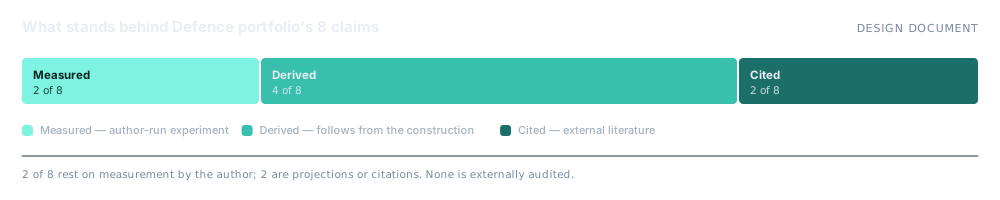
A claim is only worth the evidence attached to it. Each row below carries its basis: measured on the author’s own hardware, derived from the construction, measured on synthetic data, projected from literature, or simply cited.
| Claim | Figure | Basis | Context |
|---|---|---|---|
| Simulator-traced figures | every ballistic / thermal / lifecycle number | Derived | Untraced numbers are treated as defects |
| Result tables | 23 | Measured | Human-readable output, regenerated on any input change |
| Internal-ballistics efficiency calibration | η = 0.72 / 0.65 / 0.55 | Derived | Small arms / autocannon / tank gun |
| Terminal-ballistics calibration anchors | M80, .50 BMG, 14.5 × 114, M829-class | Cited | De Marre K = 7.80 × 10⁻⁴; Lanz–Odermatt long-rod |
| Suppressor attenuation model | 40 dB upper bound | Derived | Adiabatic-expansion limit, not a product claim |
| Body-armour calibration anchors | NIJ IIIA 9 mm, level IV 30-06 AP | Cited | V50 and back-face deformation |
| Retracted v1.0 figures | explicitly withdrawn per spec | Derived | Optimistic velocities and penetration figures corrected in place |
| Per-platform verification | PASS / FAIL on headline claims | Measured | platform_simulation.py in each folder |
Measured — author-run experiment on the stated setup. Synthetic — measured, but on synthetic rather than real data. Derived — follows from the stated construction or proof. Projected — paper-stated projection, not an author-run benchmark. Cited — taken from external literature.
How it works
- Single source of truth. One simulator, one results file, every document citing it — the discipline the whole portfolio is organised around.
- Calibration against published reference rounds. Models anchored to M80, .50 BMG, 14.5 × 114 and M829-class data rather than fitted freely.
- Parts-commonality matrix. Shared cartridges, bolt geometry, trigger recipe, liner alloy and rail standard across the whole family.
- Published retractions. Earlier optimistic figures are retracted at the top of each rewritten spec rather than silently amended.
What it does not do
Taken from the folder’s own README. Nothing here has been softened.
- The folder’s own genre note: documents adopt a defence-research register for tonal coherence. No real classification, no real programme office, and no fielded systems are implied.
- Nothing here has been built, fired or tested. Every figure is simulation output.
- Closed-form internal ballistics and De Marre penetration are engineering approximations, calibrated but not validated against these designs.
- Several v1.0 specifications carried optimistic figures that are now explicitly retracted — worth knowing if you have read an older copy.
- Combat-drug and injectable-nutrition monographs in this portfolio are speculative. Not medical advice; do not synthesise, possess or administer.
Free under AGPL-3.0+ for almost everyone
Personal use, charities, education and organisations under AUD 50,000 a year pay nothing. A tiered commercial licence covers everyone else.