Research shelf / Defence & security / Battle Sim
Written Updated
Salvo, Lanchester and Markov combat models, surveyed honestly
Combat modelling has a literature and a reputation problem: the equations are simple, the parameters are unmeasurable, and the results are used far past what the models support. This note is a reading map through that literature, and is careful to describe itself as exactly that.
Theory or design only. No in-house measurement.
A short survey of modern mathematical combat models — Hughes-style discrete salvos, extended Lanchester formulations, Markov-state battle models — with their equations and their caveats.
The survey covers three families. Hughes-style discrete salvo models treat naval engagements as exchanges of discrete strikes with staying power and defensive capacity as explicit terms — the structure that makes salvo models useful for missile-era analysis where Lanchester’s continuous attrition does not fit.
Extended Lanchester formulations cover the classical linear and square laws and their modern variants, which remain the default vocabulary for attrition modelling despite well-documented problems with parameter estimation from historical data.
Markov-state battle models represent engagements as transitions between discrete force states, which handles the discreteness and the stochasticity that the differential formulations smooth away, at the cost of a state space that grows quickly.
Every number, and what stands behind it
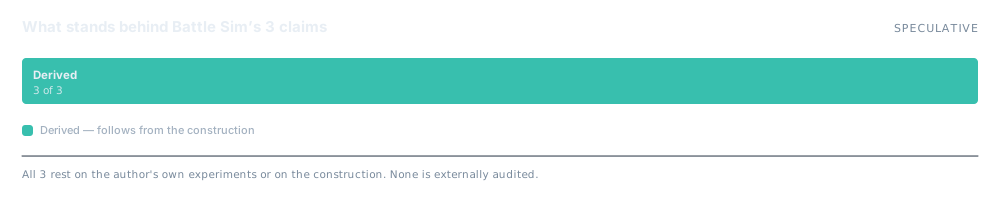
A claim is only worth the evidence attached to it. Each row below carries its basis: measured on the author’s own hardware, derived from the construction, measured on synthetic data, projected from literature, or simply cited.
| Claim | Figure | Basis | Context |
|---|---|---|---|
| Model families surveyed | 3 | Derived | Salvo, Lanchester, Markov-state |
| Document type | reading map, not operational manual | Derived | The note’s own framing |
| Content | typical equations, features, caveats | Derived | Per family |
Measured — author-run experiment on the stated setup. Synthetic — measured, but on synthetic rather than real data. Derived — follows from the stated construction or proof. Projected — paper-stated projection, not an author-run benchmark. Cited — taken from external literature.
How it works
- Hughes salvo equations. Discrete strike exchange with explicit staying-power and defensive terms.
- Lanchester linear and square laws. The classical continuous attrition formulations and their extensions.
- Markov-state transitions. Discrete force states with stochastic transitions, at the cost of state-space growth.
- Caveat-first presentation. Each family presented with its known failure modes rather than its best case.
What it does not do
Taken from the folder’s own README. Nothing here has been softened.
- This is a short survey note, not a model, an implementation or a result. It is the smallest item on this shelf.
- No parameter estimation, no validation against historical engagements, no code.
- Combat models are notoriously sensitive to parameters nobody can measure. The note says so; that does not make the models more usable.
- No original contribution to any of the three families.
- Defence framing here is analytical and historical. Nothing operational is described or implied.
Free under AGPL-3.0+ for almost everyone
Personal use, charities, education and organisations under AUD 50,000 a year pay nothing. A tiered commercial licence covers everyone else.