Research shelf / Mathematics / Math survey
Written Updated
A working map of thirteen mathematical domains, with a generator attached
Applied mathematical work has a habit of losing track of where it sits. This survey exists to fix that: thirteen domains, each with its foundations, its landmark results from the last decade, its live open problems and its connections to the others — written as a reference for people who need to situate what they are building.
Code exists and runs. Performance not independently checked.
A research-grade survey of number theory through financial mathematics — foundational theory, landmark results of the past decade, open problems, and the cross-domain connections between them.
The thirteen domains are number theory, algebra, analysis, geometry, combinatorics, logic and foundations, differential equations, numerical analysis, probability and statistics, operations research, computational mathematics, financial mathematics, and elementary mathematics. Each gets the same four-part treatment rather than being sized by the author’s interest in it.
Recent results are covered where they matter: the 2024 proof of the Geometric Langlands Conjecture by Gaitsgory, Raskin and collaborators — over 800 pages across five papers — the resolution of Brauer’s 1955 Height Zero Conjecture in representation theory, Maynard’s advances in prime distribution, and the rise of physics-informed neural networks and neural operator methods for PDEs.
The cross-cutting thread is Scientific Machine Learning as a unifying paradigm connecting numerical analysis to deep learning — which is what makes the survey useful next to the rest of this shelf rather than a standalone reference. The folder also ships a question generator, which is what its name refers to.
Every number, and what stands behind it
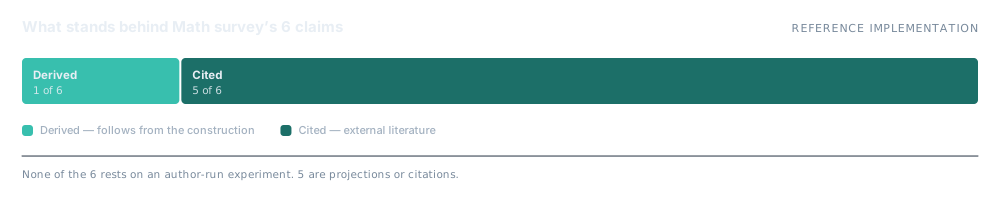
A claim is only worth the evidence attached to it. Each row below carries its basis: measured on the author’s own hardware, derived from the construction, measured on synthetic data, projected from literature, or simply cited.
| Claim | Figure | Basis | Context |
|---|---|---|---|
| Domains surveyed | 13 | Derived | Each with theory, landmarks, open problems, connections |
| Geometric Langlands proof | 2024, 800+ pages, 5 papers | Cited | Gaitsgory, Raskin et al. |
| Brauer Height Zero Conjecture | resolved | Cited | Open since 1955 |
| Prime distribution advances | Maynard | Cited | Cross-references the prime meta-pattern work on this shelf |
| PDE methods covered | PINNs, neural operators | Cited | The numerical-analysis / deep-learning bridge |
| Unifying paradigm identified | Scientific Machine Learning | Cited | The survey’s organising thread |
Measured — author-run experiment on the stated setup. Synthetic — measured, but on synthetic rather than real data. Derived — follows from the stated construction or proof. Projected — paper-stated projection, not an author-run benchmark. Cited — taken from external literature.
How it works
- Uniform four-part treatment. Foundations, decade landmarks, open problems, cross-domain links — applied identically to all thirteen domains.
- Cross-domain connection mapping. The links between domains are treated as content rather than left implicit.
- Question generator. A Python generator accompanies the survey; the folder is named for it.
- Literature currency. Results through 2024–2026, including the Langlands proof and the SciML consolidation.
What it does not do
Taken from the folder’s own README. Nothing here has been softened.
- A survey is a secondary source. Nothing here is an original mathematical result.
- Thirteen domains in one document means each gets a map, not a treatment. Depth is uniform and therefore shallow.
- Coverage reflects what was prominent at the time of writing; survey currency decays quickly.
- The generator is a utility, not a research contribution, and is not benchmarked.
- No exercises, proofs or worked derivations — this is orientation material.
Free under AGPL-3.0+ for almost everyone
Personal use, charities, education and organisations under AUD 50,000 a year pay nothing. A tiered commercial licence covers everyone else.