Research shelf / Policy & economics / UN reform
Written Updated
The enforcement gap, and a proposal that prices its own failure
The UN separates moral authority from enforcement power, and the paper’s argument is that this is architectural rather than incidental: Rwanda, Srebrenica, Syria, Ukraine, Gaza, Tigray and Yemen are not seven failures of will but one structural feature producing the same outcome repeatedly.
Theory or design only. No in-house measurement.
A standing UN Defence Force under an elected Security Commissioner, argued from Charter articles and treaty law, with a closing section on why it probably will not be adopted.
The argument runs in four moves. First an empirical reckoning with the enforcement gap across seven named cases. Second a structural diagnosis — the sovereignty paradox, the consent problem, and the deterrence deficit — explaining why the failure recurs. Third a legal grounding in Charter Articles 1, 2(4), 24, 25, 39, 41, 42, 47, 51, 99 and 108, the 1948 Genocide Convention, the Geneva Conventions and their Additional Protocols, and the Rome Statute.
Fourth, an institutional design: a 50,000-personnel six-brigade United Nations Defence Force; an elected Security Commissioner accountable to the General Assembly and reviewable by the International Court of Justice; a pre-committed trigger-event framework so intervention is not a fresh political decision each time; and a tiered GDP-bracketed funding model. The pathway is designed so that it does not require P5 consent to begin, and requires it only at the final step.
The paper then engages four canonical objections — world government in disguise, the P5 will never agree, the force will be captured, states will leave rather than submit — and four predecessor proposals: the Ezulwini Consensus, Uniting for Peace, Annan’s In Larger Freedom, and the Responsibility to Protect doctrine, explaining where it converges with and diverges from each.
Every number, and what stands behind it
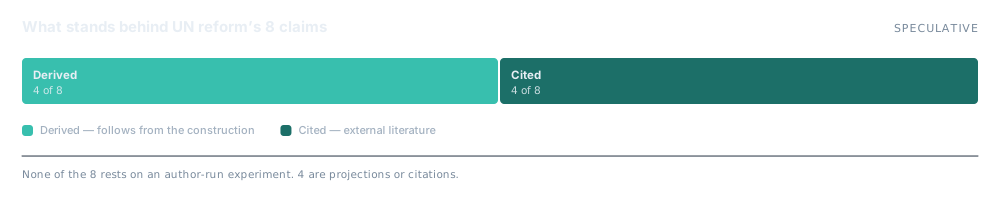
A claim is only worth the evidence attached to it. Each row below carries its basis: measured on the author’s own hardware, derived from the construction, measured on synthetic data, projected from literature, or simply cited.
| Claim | Figure | Basis | Context |
|---|---|---|---|
| Enforcement-gap cases examined | 7 | Cited | Rwanda, Srebrenica, Syria, Ukraine, Gaza, Tigray, Yemen |
| Proposed force size | 50,000 personnel, six brigades | Derived | Institutional design parameter |
| Charter articles grounded in | 11 | Cited | Articles 1, 2(4), 24, 25, 39, 41, 42, 47, 51, 99, 108 |
| Treaty basis | Genocide Convention, Geneva Conventions, Rome Statute | Cited | Plus the Additional Protocols |
| Accountability structure | elected, GA-accountable, ICJ-reviewable | Derived | The check against the capture objection |
| Funding model | tiered GDP brackets | Derived | Design parameter |
| P5 consent required | only at the final step | Derived | The pathway’s central procedural claim |
| Predecessor proposals engaged | 4 | Cited | Ezulwini, Uniting for Peace, In Larger Freedom, R2P |
Measured — author-run experiment on the stated setup. Synthetic — measured, but on synthetic rather than real data. Derived — follows from the stated construction or proof. Projected — paper-stated projection, not an author-run benchmark. Cited — taken from external literature.
How it works
- Structural rather than moral diagnosis. The sovereignty paradox, consent problem and deterrence deficit treated as architecture, not as failures of will.
- Charter-internal grounding. The proposal argued from articles the Charter already contains, including the long-dormant Article 47.
- Pre-committed trigger framework. Intervention conditions fixed in advance so each case is not a fresh political negotiation.
- Objection-and-predecessor engagement. Four standard objections and four prior proposals addressed explicitly rather than left to the reader.
What it does not do
Taken from the folder’s own README. Nothing here has been softened.
- The paper’s own closing position: it does not claim the proposal will be adopted in the form presented.
- Low probability of P5 ratification on a single-generation horizon — stated as a risk by the author.
- Risk of the force being captured by contributing states, and of mission creep beyond the trigger events.
- Risk that trigger-event determinations themselves become politicised, which would reproduce the problem inside the new institution.
- Fiscal sustainability under a global recession is named as unresolved.
Free under AGPL-3.0+ for almost everyone
Personal use, charities, education and organisations under AUD 50,000 a year pay nothing. A tiered commercial licence covers everyone else.