Research shelf / Policy & economics / UCN
Written Updated
An entire political system, designed so the parts don’t contradict each other
There is an old genre where an author works out a complete coherent system — the constitution, the economy, the foreign policy, the safety net — and checks that the pieces fit. The UCN papers are that exercise written in policy-research register rather than fiction, anchored to an explicit macroeconomic model, and closed by a roadmap that admits what it would require and does not have.
Theory or design only. No in-house measurement.
Eight numbered papers covering constitution, economy, defence, IP, drug policy and foreign relations — every claim sourced, every incompatibility with current law acknowledged in the roadmap.
The series is eight numbered papers — Framework, Sovereignty, Defence, Social, IP, Constitution, Foreign Policy, Roadmap — plus an economic backbone in the Energy-Resource Economic Model, a sovereign-digital-currency analysis, a constitutional-law reading of the Australian status quo, and a supporting two-part study of Western nuclear procurement failure. The design constraint is internal consistency: the drug policy has to be affordable under the economics, the defence posture has to be consistent with the foreign policy.
The distinguishing moves are specific rather than gestural: a modular constitution with version-control semantics and tiered amendment thresholds; an EREM-backed currency with an AUD 100 M personal wealth ceiling; citizen-only residential property and direct share ownership; a Public Knowledge Mandate with no embargo period; a minimal deterrent capped at ten warheads alongside a year of non-weapons national service; government-manufactured pharmaceutical-grade recreational drugs under Portuguese-style decriminalisation; and 185 non-aggression pacts derived from the Correlates of War dataset with no trade partner above 20% of goods exports.
Every claim carries a citation — the roughly 80% fall in Portuguese overdose deaths over twenty years, El Salvador’s 92% Bitcoin non-use figure, the Atlantic Council’s 137-jurisdiction CBDC tracker. A separate strand runs to a companion folder on an optional Crown confederation of Australia, Canada and the United Kingdom, in which the Crown performs defined governance functions rather than serving as a shared symbol.
Every number, and what stands behind it
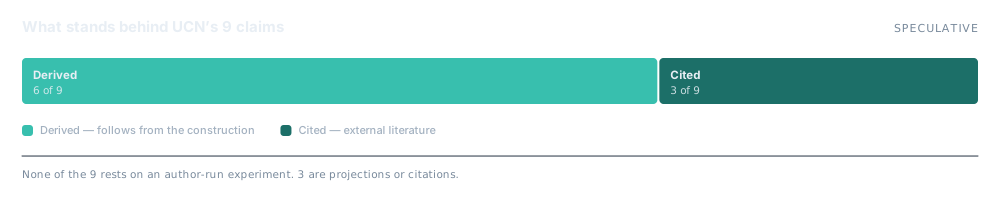
A claim is only worth the evidence attached to it. Each row below carries its basis: measured on the author’s own hardware, derived from the construction, measured on synthetic data, projected from literature, or simply cited.
| Claim | Figure | Basis | Context |
|---|---|---|---|
| Papers in the core series | 8 | Derived | Framework through Roadmap, plus supporting studies |
| Personal wealth ceiling | AUD 100 M | Derived | Design parameter |
| Nuclear posture | ≤ 10 warheads | Derived | Minimal deterrence — incompatible with NPT as noted |
| Non-aggression pacts | 185 | Derived | Derived from the Correlates of War dataset |
| Trade concentration limit | no partner > 20% of goods exports | Derived | Sovereignty constraint |
| Portuguese decriminalisation outcome | ~80% overdose-death reduction over 20 years | Cited | Real-world evidence anchor |
| El Salvador Bitcoin non-use | 92% | Cited | Cited against the crypto-settlement proposal |
| CBDC jurisdictions tracked | 137 | Cited | Atlantic Council tracker |
| Research levy | 1.5% of revenue to approved research | Derived | Design parameter in the IP paper |
Measured — author-run experiment on the stated setup. Synthetic — measured, but on synthetic rather than real data. Derived — follows from the stated construction or proof. Projected — paper-stated projection, not an author-run benchmark. Cited — taken from external literature.
How it works
- Whole-system consistency. Papers written so proposals cannot contradict each other — the constraint that makes the exercise hard.
- Version-controlled constitution. Tier 1/2/3 amendment thresholds, so different provisions carry different change costs.
- EREM as macroeconomic backbone. Currency and wealth policy grounded in an explicit energy-and-resource model rather than left implicit.
- Sourced evidence anchors. Every empirical claim tied to a citation — Portuguese drug policy, CBDC adoption, procurement data.
What it does not do
Taken from the folder’s own README. Nothing here has been softened.
- Explicitly policy research, not enacted law. Nothing here has legal standing anywhere.
- Many proposals contradict current Australian law and NPT, Five Eyes and IMF frameworks. The roadmap paper says so directly.
- A ten-warhead deterrent is incompatible with Australia’s NPT obligations as a non-nuclear-weapon state.
- The roadmap acknowledges the proposal would need referenda, elections and international consent it does not have.
- A designed system’s internal coherence says nothing about whether it would survive contact with actual politics.
Free under AGPL-3.0+ for almost everyone
Personal use, charities, education and organisations under AUD 50,000 a year pay nothing. A tiered commercial licence covers everyone else.