Research shelf / Policy & economics / EREM · SPX
Written Updated
Wealth measured in megajoules, and a structural read on SPX call volume
EREM asks what happens if you measure national wealth in megajoules instead of currency — petroleum reserves, manufacturing capacity, food and water security, and human labour all recast into one physical unit. SPX asks why daily call notional grew 867-fold since 1999, and what five different curve families say about where that ends.
Specified in detail; implementation partial or absent.
Two lines: recasting national wealth into physical energy units to break the circular dependency on monetary institutions, and five models converging on a 2028–2029 window for a gamma unwind.
EREM (Energy-Resource Economic Model) proposes measuring national wealth in megajoules rather than currency-denominated GDP. Total National Wealth is a weighted sum: TNW = 0.40·NEW + 0.25·MWI + 0.20·FEW + 0.10·HLC + 0.05·IEF — natural energy wealth, manufacturing, food/energy/water, human and labour capacity, and information efficiency. Currency issuance follows Total_currency = 0.85 · TNW, and exchange rates become a direct ratio of per-capita TNW between nations, with no monetary-policy translation layer.
SPX Call Volume analyses structural instability in options markets. Daily SPX call notional reached USD 2.6 trillion on 7 May 2026 — an 867-fold increase since 1999. Five quantitative models (super-exponential, logistic, hyperbolic blow-up, Sornette log-periodic, and hazard-rate) all converge on a 2028–2029 base-case window for a high-speed gamma unwind, with roughly 10% early-tail probability inside 6–12 months, and a potential 20–35% index correction.
The two lines share a method: take a quantity everyone treats as given, ask what it is actually measuring, and see whether a different unit or a different curve family changes the answer.
Every number, and what stands behind it
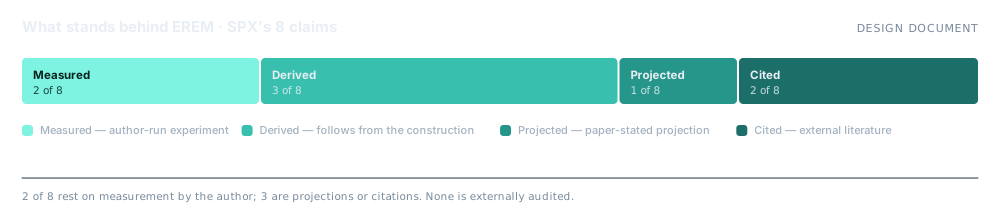
A claim is only worth the evidence attached to it. Each row below carries its basis: measured on the author’s own hardware, derived from the construction, measured on synthetic data, projected from literature, or simply cited.
| Claim | Figure | Basis | Context |
|---|---|---|---|
| TNW formula | 0.40·NEW + 0.25·MWI + 0.20·FEW + 0.10·HLC + 0.05·IEF | Derived | Weights are priors, not derived |
| Currency issuance rule | Total_currency = 0.85 · TNW | Derived | Removes trust in monetary institutions from the loop |
| Exchange rate | Direct per-capita TNW ratio | Derived | No monetary-policy translation layer |
| SPX daily call notional | USD 2.6 trillion, 7 May 2026 | Cited | Public CBOE statistics |
| Growth since 1999 | 867-fold | Cited | Public CBOE statistics |
| Base-case unwind window | 2028–2029 | Measured | Five models converge |
| Early-tail probability | ~10% within 6–12 months | Measured | Hazard-rate model |
| Potential correction | 20–35% index | Projected | Conditional on the unwind occurring |
Measured — author-run experiment on the stated setup. Synthetic — measured, but on synthetic rather than real data. Derived — follows from the stated construction or proof. Projected — paper-stated projection, not an author-run benchmark. Cited — taken from external literature.
How it works
- Physical-unit recasting. Every wealth component expressed in megajoules.
- Five model families (SPX). Super-exponential, logistic, hyperbolic blow-up, Sornette log-periodic, hazard-rate.
- Public data anchoring. SPX analysis uses published CBOE statistics.
What it does not do
Taken from the folder’s own README. Nothing here has been softened.
- EREM is v1.0 and theoretical. Its weighting coefficients are priors, not derived quantities.
- EREM requires national-level physical-resource audits that do not currently exist.
- The SPX analysis is explicitly not investment advice.
- Curve fitting extrapolates from a feedback-loop mechanism that could change structure or face regulatory intervention at any point.
Free under AGPL-3.0+ for almost everyone
Personal use, charities, education and organisations under AUD 50,000 a year pay nothing. A tiered commercial licence covers everyone else.