Research shelf / Tracking & sensors / ARIA-INTEL
Written Updated
ARIA-INTEL — multi-source tracking to actionable intelligence, on one CPU core
One Python module, two dependencies, no GPU. ARIA-INTEL runs a Poisson Multi-Bernoulli Mixture tracker with Mixed Ornstein–Uhlenbeck motion, then routes confirmed tracks through pattern-of-life anomaly detection, eight tradecraft detectors and Dempster-Shafer threat fusion — at a median 28 ms per scan on a single core.
Code exists and runs. Performance not independently checked.
A PMBM random-finite-set tracker with pattern-of-life modelling, eight tradecraft detectors and Bayesian threat scoring — 2,363 lines, NumPy and SciPy only, 28 ms per scan.
ARIA-INTEL converts raw multi-source location observations into ranked intelligence. It is a single Python module of roughly 2,363 lines requiring only NumPy and SciPy, and it processes a scan in a median 28 milliseconds on one CPU core with no GPU.
The tracking core is a Poisson Multi-Bernoulli Mixture random-finite-set tracker with Mixed Ornstein–Uhlenbeck motion modelling and 320-particle filtering, using Gibbs-sampled data association over 14 sweeps rather than nearest-neighbour assignment. Every track carries an explicit Bernoulli existence probability.
Downstream of tracking sit spatio-temporal pattern-of-life Gaussian mixtures, eight hot-swappable detectors (rendezvous warning with three stacked geometric methods, parallel-route surveillance, mode transition, loiter, dead drop, chokepoint, network analysis) and 8-dimensional Beta-Monte-Carlo threat integration via Dempster-Shafer fusion. Domain changes — urban HUMINT, maritime, airspace, convoy, city-camera, border, fugitive — are configuration swaps through DomainProfile objects, not code changes.
Every number, and what stands behind it
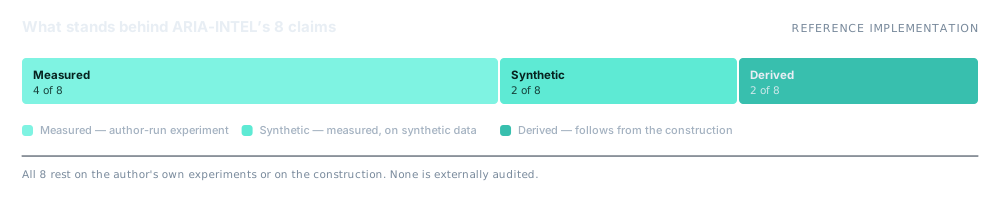
A claim is only worth the evidence attached to it. Each row below carries its basis: measured on the author’s own hardware, derived from the construction, measured on synthetic data, projected from literature, or simply cited.
| Claim | Figure | Basis | Context |
|---|---|---|---|
| Median scan latency | 28 ms, single CPU core | Measured | No GPU |
| Throughput | ~20 scans/second | Measured | Same setup |
| Rendezvous warning recall | 100% (20/20 scenarios) | Synthetic | Synthetic scenarios, 28.1-minute mean lead time |
| Mean position error | 21.8 m | Synthetic | Synthetic scenario generators |
| Scaling | Linear to 50+ tracks | Measured | |
| Data association | Gibbs sampling, 14 sweeps | Derived | vs nearest-neighbour |
| Motion filtering | 320 particles | Derived | Mixed Ornstein–Uhlenbeck |
| Module size | ~2,363 lines, NumPy + SciPy only | Measured |
Measured — author-run experiment on the stated setup. Synthetic — measured, but on synthetic rather than real data. Derived — follows from the stated construction or proof. Projected — paper-stated projection, not an author-run benchmark. Cited — taken from external literature.
How it works
- PMBM random-finite-set tracking. Per-track Bernoulli existence probability rather than a hard track list.
- Mixed Ornstein–Uhlenbeck motion. With 320-particle filtering.
- Gibbs-sampled association. 14 sweeps, a principled alternative to nearest-neighbour.
- Eight hot-swappable detectors. Rendezvous, parallel-route, mode transition, loiter, dead drop, chokepoint, network role.
- Dempster-Shafer threat fusion. 8-dimensional Beta-Monte-Carlo integration.
- DomainProfile polymorphism. Scan period, rendezvous horizon, spatial gating and motion libraries as configuration.
What it does not do
Taken from the folder’s own README. Nothing here has been softened.
- No third-party validation of any figure.
- Pattern-of-life modelling requires at least 15 observations before it produces anything.
- The Paper 2 deployment profiles are specifications, not shipped code.
- No camera re-identification pipeline is included.
- No audit-trail logging is implemented — which matters for the law-enforcement use cases the brief describes.
Free under AGPL-3.0+ for almost everyone
Personal use, charities, education and organisations under AUD 50,000 a year pay nothing. A tiered commercial licence covers everyone else.