Research shelf / Tracking & sensors / GH-SR-IMM
Written Updated
GH-SR-IMM — separating heavy tails from manoeuvre
Standard trackers conflate two different problems: measurement noise with heavy tails, and targets that manoeuvre. Handle them with one mechanism and each degrades the other. GH-SR-IMM separates them — and fixes a specific failure where a naive heavy-tailed likelihood silently decides every measurement is clutter.
Experiments were run and the numbers are reported here.
A heavy-tailed multi-target tracker that decouples outlier robustness from manoeuvre handling, reporting a 51.6% average GOSPA improvement.
The tracker combines Normal-Inverse-Gaussian measurement noise with conjugate scale updates, a three-model Interacting-Multiple-Model bank (constant velocity, constant acceleration with AR jerk, and an H∞ adversarial model), and square-root cubature Kalman filtering for numerical stability under heavy-tailed posteriors.
The central correction is in the data association step. Feeding a raw generalised-hyperbolic likelihood into joint probabilistic data association silently overweights the hypothesis that all measurements are clutter. The fix is to use the GH posterior covariance R_eff inside a Gaussian association likelihood — keeping heavy-tail robustness in estimation without letting it corrupt association.
The result of separating the two concerns: GH estimation applies per-model, IMM mixing handles manoeuvre adaptation, and neither is asked to compensate for the other.
Every number, and what stands behind it
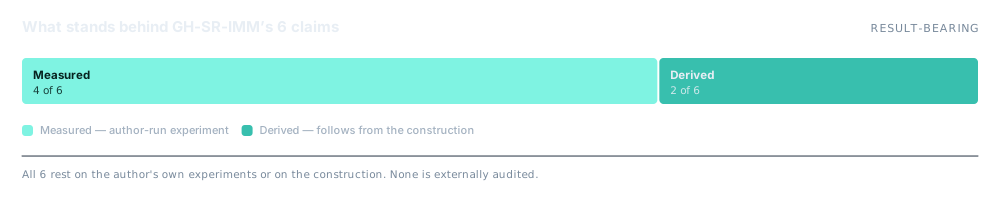
A claim is only worth the evidence attached to it. Each row below carries its basis: measured on the author’s own hardware, derived from the construction, measured on synthetic data, projected from literature, or simply cited.
| Claim | Figure | Basis | Context |
|---|---|---|---|
| Multi-target GOSPA improvement | 51.6% average | Measured | Across four scenarios |
| Peak GOSPA improvement | 72.8% | Measured | Best of the four scenarios |
| Single-target composite score | 1.090 | Measured | 38% better than Student-t baseline |
| vs variational-Bayes baseline | 69% better | Measured | Single-target composite |
| Association correction | R_eff inside a Gaussian likelihood | Derived | The core methodological fix |
| Filter bank | 3 models: CV, CA+AR jerk, H∞ | Derived | IMM |
Measured — author-run experiment on the stated setup. Synthetic — measured, but on synthetic rather than real data. Derived — follows from the stated construction or proof. Projected — paper-stated projection, not an author-run benchmark. Cited — taken from external literature.
Why a heavy tail breaks a Gaussian tracker
A target moves; a sensor reports its position with noise. Most of the time that noise is well behaved. Occasionally it is not — a glint, a reflection, a clutter return lands far from truth. Turn the outlier rate up and watch what each filter does with it.
GH-SR-IMM — heavy-tailed estimation
Both filters see identical measurements. The Gaussian filter trusts every one of them in proportion to its distance; the heavy-tailed filter down-weights a return that is far enough out to be implausible, rather than letting it drag the estimate.
How it works
- Normal-Inverse-Gaussian noise. With conjugate scale updates.
- Three-model IMM. Constant velocity, constant acceleration with AR jerk, H∞ adversarial.
- Square-root cubature KF. Stable covariance factorisation under heavy-tail posteriors.
- IW-Q / IW-R adapters. Online process and measurement noise tracking.
- AR-ρ estimation. Online jerk autocorrelation for the acceleration model.
- ACF monitor. Fault detection through innovation analysis.
What it does not do
Taken from the folder’s own README. Nothing here has been softened.
- The IMM transition matrix is fixed, not learned online.
- The multi-target benchmark assumes a known track count and near-truth initialisation — a generous setup.
- One hyperparameter variant does not consistently beat the baseline.
- Single-target and multi-target implementations differ in architectural completeness.
Free under AGPL-3.0+ for almost everyone
Personal use, charities, education and organisations under AUD 50,000 a year pay nothing. A tiered commercial licence covers everyone else.