Research shelf / AI & machine learning / Ashby Optimiser
Written Updated
Ross Ashby’s 1948 homeostat, rebuilt as a multi-scale optimiser
W. Ross Ashby built the homeostat in 1948 to demonstrate that a system of independently adapting units could find stability without any of them knowing the whole. This optimiser takes the constraint seriously: each unit updates only from its own proposals, every unit gets an equal share of the budget, and the only structure imposed is that their search radii are geometrically spaced.
Experiments were run and the numbers are reported here.
N isolated search units at geometrically spaced radii, round-robin scheduled, with homeostatic restarts on stagnation — benchmarked honestly against random search and a (1+1)-ES.
The design constraints are deliberately restrictive. Unit isolation means each search unit updates only from proposals it generated itself — no sharing of the incumbent best, no crossover, no migration. Equal budget allocation means strict round-robin scheduling rather than adaptive resource reallocation towards promising units.
What the units do not share is compensated for by what they differ in: each runs at a distinct search radius, geometrically spaced across scales — the paper’s "gear ratio". A unit that stagnates triggers a homeostatic restart, the direct analogue of Ashby’s uniselector stepping to a new random configuration when the system left its viable range.
The benchmark is deliberately conventional: Sphere, Rastrigin, Rosenbrock and Ackley at dimensions 2 through 50, against random search and a (1+1) evolution strategy with step-size adaptation. The gains are concentrated where you would expect them — multi-modal problems, where a single search scale gets trapped.
Every number, and what stands behind it
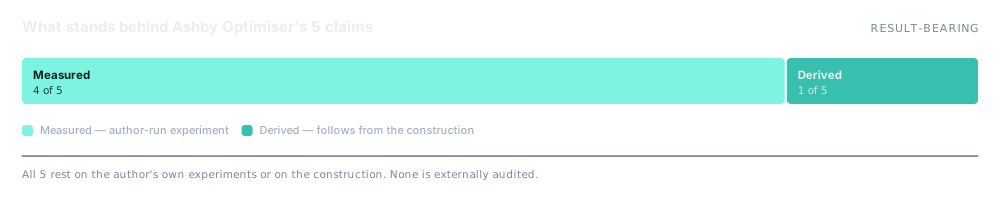
A claim is only worth the evidence attached to it. Each row below carries its basis: measured on the author’s own hardware, derived from the construction, measured on synthetic data, projected from literature, or simply cited.
| Claim | Figure | Basis | Context |
|---|---|---|---|
| Rastrigin median error, 1 unit → 4 units | 74.7 → 0.002 | Measured | dim = 10, 500 evaluations |
| Error at 1,000 evaluations | near zero across all dimensions to 50 | Measured | Author-run benchmark on the four standard functions |
| Benchmark suite | Sphere, Rastrigin, Rosenbrock, Ackley | Measured | Dimensions 2–50 |
| Baselines compared | random search, (1+1)-ES with step-size adaptation | Measured | Same evaluation budget |
| Design constraint | strict unit isolation, equal budget | Derived | Enforced by construction, not a tuned choice |
Measured — author-run experiment on the stated setup. Synthetic — measured, but on synthetic rather than real data. Derived — follows from the stated construction or proof. Projected — paper-stated projection, not an author-run benchmark. Cited — taken from external literature.
How it works
- Geometric gear ratios. Search radii spaced geometrically across units, so the population spans scales rather than converging on one.
- Strict round-robin. Equal evaluation budget per unit, with no adaptive reallocation — the constraint that makes the result attributable to multi-scale structure.
- Unit isolation. Each unit updates only from its own proposals. No information flows between units.
- Homeostatic restart. A stagnating unit re-randomises, mirroring the uniselector in Ashby’s original machine.
What it does not do
Taken from the folder’s own README. Nothing here has been softened.
- The paper states its own relationship to existing multi-start and restart methods rather than claiming novelty over them.
- Gains are concentrated on multi-modal functions. On Sphere and Rosenbrock the multi-scale structure buys much less.
- Four synthetic benchmark functions are not a real optimisation workload.
- Dimensions tested stop at 50. Behaviour in the hundreds or thousands is unknown.
- Unit isolation is a constraint chosen for conceptual fidelity to Ashby, not because it was shown to beat communicating units.
Free under AGPL-3.0+ for almost everyone
Personal use, charities, education and organisations under AUD 50,000 a year pay nothing. A tiered commercial licence covers everyone else.