Research shelf / Information theory / Izaac · GRIA · NMP
Written Updated
Three frameworks for compression under one vocabulary
Lossless coding, distribution compression and neural representation are usually studied with three separate vocabularies. This work proposes one: a deterministic shared pseudo-random stream σ, a reversibility grade α, and a spectral exponent that makes a neural network measurable as a compressor.
Experiments were run and the numbers are reported here.
Shared-PRF coordination, graded reversibility, and neural networks treated as measurable compression operators — unified under one information-theoretic vocabulary.
Izaac introduces deterministic shared-PRF coordination together with a "free broadcast channel" meta-theorem. The unifying mechanism is σ, a deterministic shared pseudo-random stream of size Θ(λ + log k), which supports fast-forward in O(log n) time — O(1) in CTR mode.
GRIA grades compression systems along a reversibility axis α ∈ [0, 1], so that lossless and lossy are endpoints of one scale rather than two categories. Eleven axioms define its algebra.
NMP treats neural networks as compression operators with a measurable spectral exponent, reported at α ≈ 0.851 ± 0.122. Ten theorems structure the Izaac foundation; the frameworks ship reference Python implementations and technical memoranda.
Every number, and what stands behind it
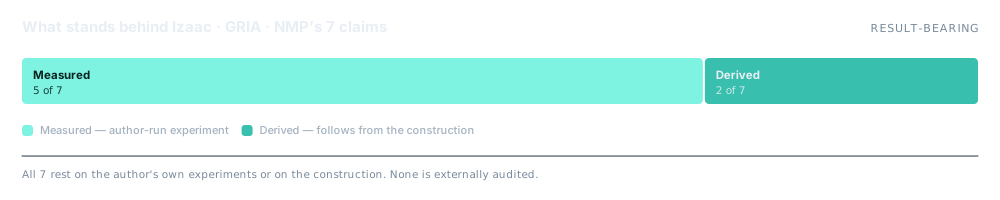
A claim is only worth the evidence attached to it. Each row below carries its basis: measured on the author’s own hardware, derived from the construction, measured on synthetic data, projected from literature, or simply cited.
| Claim | Figure | Basis | Context |
|---|---|---|---|
| Spectral exponent (NMP) | α ≈ 0.851 ± 0.122 | Measured | Across NMP configurations |
| MDL-optimal bottleneck | P* = 45 → 218.7:1 effective ratio | Measured | Memoriser study: 30 documents, 512 hidden dims, 300 epochs |
| GRIA J-score | 0.889 vs 0.742 baseline | Measured | Jeffries-style metric |
| Theoretical J ceiling | J ≤ 0.951 | Derived | From the GRIA axioms |
| Coding improvement | gzip ~3.2 → ~1.2 bits/char style gains | Measured | Author-reported, specific setup |
| Fast-forward cost | O(log n), O(1) in CTR mode | Derived | Property of the σ construction |
| Regression fit across NMP configs | R² 0.75 – 0.97 | Measured | Range, not a single figure |
Measured — author-run experiment on the stated setup. Synthetic — measured, but on synthetic rather than real data. Derived — follows from the stated construction or proof. Projected — paper-stated projection, not an author-run benchmark. Cited — taken from external literature.
How it works
- Ten theorems (Izaac). Structure the shared-PRF coordination foundation.
- Eleven axioms (GRIA). Define the algebra of graded reversibility on α ∈ [0, 1].
- Spectral measurement (NMP). Networks characterised by a measurable spectral exponent rather than a parameter count.
- Reference implementations. Python, with technical memoranda giving experimental specifications.
What it does not do
Taken from the folder’s own README. Nothing here has been softened.
- Requires secure σ setup — compromise causes predictability collapse.
- "Shannon-breaking" claims depend on Wyner–Ziv side-information setups. They are not unconditional violations of the source coding theorem.
- The consensus tables underspecify: leader selection requires zero messages, but proposal propagation still demands messaging.
- Author-reported metrics only. No third-party benchmarks.
- R² varies widely (0.75 – 0.97) across NMP configurations.
Free under AGPL-3.0+ for almost everyone
Personal use, charities, education and organisations under AUD 50,000 a year pay nothing. A tiered commercial licence covers everyone else.