Research shelf / AI & machine learning / Fungal Network Algorithm
Written Updated
Topology as memory — a network that stores history in its own shape
In a conventional neural network the weights are where the information lives. This asks what a network looks like if the topology itself is the memory — where edges exist because history put them there, allocation is entirely local, and the structure grows, optimises and stabilises with no central control.
Specified in detail; implementation partial or absent.
A bio-inspired self-organising network where edges and weights are the consequence of input history rather than the storage medium, growing and pruning by purely local rules.
The algorithm formalises four principles taken from fungal foraging. Topology as memory: weights and edges are not the storage medium, they are the consequence of input history. Decentralised emergence: all routing and allocation decisions stay local, with no central controller.
Geometric state evolution: the network moves through exploration, connection, optimisation and stabilisation phases driven by simple local rules rather than a scheduler. Resource-driven adaptation: more "hyphae" are allocated to productive regions and unproductive connections are pruned, on local feedback alone.
The folder ships a design-conversation transcript alongside three concept papers — a philosophy and applications overview, a single-instance mathematical model, and a distributed extension — plus a Python reference implementation.
Every number, and what stands behind it
A claim is only worth the evidence attached to it. Each row below carries its basis: measured on the author’s own hardware, derived from the construction, measured on synthetic data, projected from literature, or simply cited.
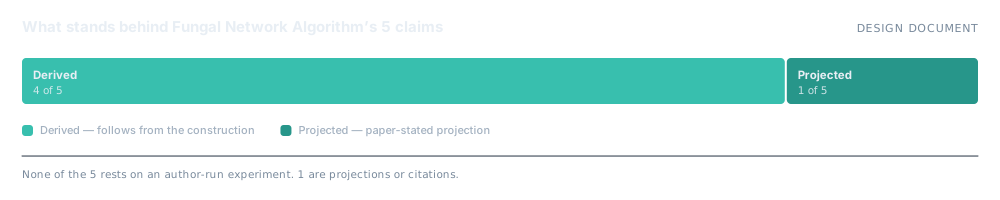
| Claim | Figure | Basis | Context |
|---|---|---|---|
| Topology as memory | Edges are the consequence of history, not the store | Derived | Core design principle |
| Decentralised emergence | All routing and allocation decisions are local | Derived | No central control |
| Four-phase evolution | Exploration → connection → optimisation → stabilisation | Derived | Driven by local rules |
| Resource-driven adaptation | Growth toward productive regions, pruning elsewhere | Derived | Local feedback only |
| Benchmark performance | Not measured | Projected | No comparison against standard graph algorithms |
Measured — author-run experiment on the stated setup. Synthetic — measured, but on synthetic rather than real data. Derived — follows from the stated construction or proof. Projected — paper-stated projection, not an author-run benchmark. Cited — taken from external literature.
How it works
- Single-instance mathematical model. The core dynamics written out formally.
- Parallel/distributed extension. A second model for the distributed case.
- Python reference implementation.
FungalNA.py, v1.
What it does not do
Taken from the folder’s own README. Nothing here has been softened.
- One generation shipped. v1 only; later versions are planned but not included.
- The work formalises four principles abstracted from fungal biology — it does not simulate actual fungi.
- Performance is entirely unvalidated. Theoretical and qualitative analysis only, with no benchmarks against standard graph algorithms.
Free under AGPL-3.0+ for almost everyone
Personal use, charities, education and organisations under AUD 50,000 a year pay nothing. A tiered commercial licence covers everyone else.