Research shelf / AI & machine learning / VERITAS
Written Updated
A learner that proves each step is allowed before it takes it
Learning theory usually works like this: you train a model, then you analyse it and derive a bound that would have held. VERITAS inverts the order. Every learning step is checked against the conditions its PAC and ALT bounds require, at the moment it is taken, and a step that fails the check does not happen.
Code exists and runs. Performance not independently checked.
Nine theorems over binary pattern spaces, with PAC and ALT guarantees checked at runtime rather than argued offline — and a composition result showing the guarantees add.
The name expands to Verification-Enabled Reasoning and Integrated Theorem-Acquiring System. It is a meta-learning architecture over binary pattern spaces, structured across four nested spaces, with nine theorems covering metric-space completeness, PAC learning bounds, ALT (algorithmic learning theory) mistake bounds, meta-learning theory, verification completeness and composition.
The central result is Theorem 9, on composition: if the base learner achieves error ε with confidence 1−δ, and the meta-learner achieves meta-error εm with confidence 1−δm, the composed system achieves error ε + εm with confidence 1−(δ + δm). Additive, in both terms. That is what makes hierarchical composition safe rather than merely plausible.
The architecture is deliberately expensive. Sample complexity is superexponential by design — ln|H| = 2ⁿ · ln 2 for a hypothesis space over n-dimensional binary patterns — which forces evidence to accumulate before any step is certified. A distillation regime handles ensemble-to-student transfer, and the whole ships as a NumPy reference implementation across four modules.
Every number, and what stands behind it
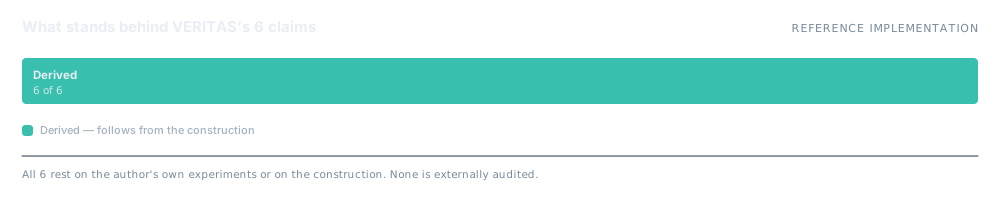
A claim is only worth the evidence attached to it. Each row below carries its basis: measured on the author’s own hardware, derived from the construction, measured on synthetic data, projected from literature, or simply cited.
| Claim | Figure | Basis | Context |
|---|---|---|---|
| Composition guarantee | ε + ε_m at confidence 1 − (δ + δ_m) | Derived | Theorem 9 — the central result |
| Theorems established | 9 | Derived | Completeness, PAC, ALT, meta-learning, verification, composition |
| Sample complexity | ln|H| = 2ⁿ · ln 2 | Derived | Superexponential — a design choice, not a flaw |
| Nested spaces | 4 | Derived | The architecture’s structural layering |
| Verification timing | every learning step | Derived | Runtime proof traces, not offline analysis |
| Reference implementation | NumPy, 4 modules | Derived | core, verification, distillation, integration |
Measured — author-run experiment on the stated setup. Synthetic — measured, but on synthetic rather than real data. Derived — follows from the stated construction or proof. Projected — paper-stated projection, not an author-run benchmark. Cited — taken from external literature.
How it works
- Runtime PAC/ALT verification. Each step checked against the conditions its bound requires before it is applied — the inversion that defines the system.
- Four-proof runtime architecture. Proof traces generated during learning rather than reconstructed after it.
- Hierarchical meta-learning. Base guarantees composed upward through the meta layer, with Theorem 9 fixing the arithmetic.
- Knowledge distillation regime. Ensemble-to-student transfer with its own theoretical treatment.
What it does not do
Taken from the folder’s own README. Nothing here has been softened.
- Superexponential sample complexity is stated as intentional. It is also, in practice, the thing that keeps this to small n.
- Binary pattern spaces only. Nothing here addresses continuous inputs or real-valued features.
- Additive composition is the honest bound and also the pessimistic one: errors add rather than partially cancel.
- NumPy reference implementation. No performance work, no scale results.
- The nine theorems are stated and proved in the paper; there is no machine-checked formalisation despite the verification framing.
Free under AGPL-3.0+ for almost everyone
Personal use, charities, education and organisations under AUD 50,000 a year pay nothing. A tiered commercial licence covers everyone else.