Research shelf / Cryptography / RNG portfolio
Written Updated
Four random number generators, built on four different physical metaphors
Most RNG work picks one construction and defends it. This folder builds four, from four unrelated metaphors, and reports each one’s statistics honestly including the one that is only 739 bits of state on a Cortex-M4 and the one that was fixed after v1 failed a correlation test.
Experiments were run and the numbers are reported here.
Transcendental-constant DAG, Boolean LCG, dual-attractor chaos and counter-rotating turbulence — four generators with genuinely different failure modes, benchmarked separately.
The Meta-DAG RNG seeds from eight classical transcendental constants (π, e, √2, φ, ζ(3), γ, Catalan’s, Glaisher–Kinkelin), mixes through eight self-modifying bitwise and arithmetic meta-operations whose selection is driven by the evolving state, and diffuses across an eight-node directed acyclic graph with dynamically evolving paths. Total state space 21536 × 40320.
The OTB-LCG takes the opposite approach — classical linear congruential theory at 256-bit width, with maximum period guaranteed by Hull–Dobell, XOR-based Boolean parity functions for parameter generation, multi-source hardware entropy, Von Neumann bias correction and SHA-256 post-processing. The Boolean parameter layer eliminates the 22.66% bias characteristic of naive LCG implementations.
SynerChaos v2 targets embedded constraints: dual-attractor integer chaotic maps with cross-layer coupling, a 32-bit maximal LFSR for temporal decorrelation, and a dual-mixer output stage with 8-octant bias correction, in 739 bits of state and 80 bytes of memory. TurbulentFlow generates decimal digits directly, evolving two 32-bit streams in opposite rotational directions from one seed and XOR-combining them so per-stream correlations destroy each other.
Every number, and what stands behind it
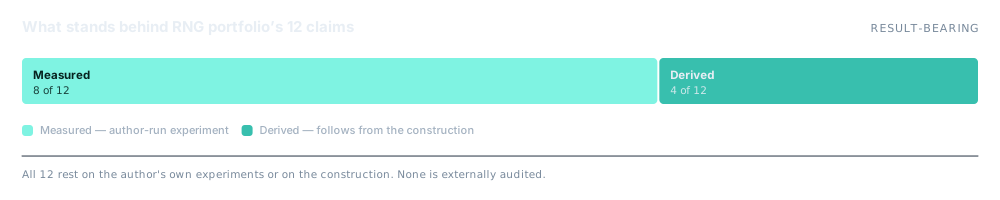
A claim is only worth the evidence attached to it. Each row below carries its basis: measured on the author’s own hardware, derived from the construction, measured on synthetic data, projected from literature, or simply cited.
| Claim | Figure | Basis | Context |
|---|---|---|---|
| Meta-DAG state space | 2¹⁵³⁶ × 40320 | Derived | Eight nodes, eight meta-operations, permutation term |
| Meta-DAG entropy rate | ≥63.9 bits per 64-bit output | Derived | Estimated, not measured |
| Meta-DAG period lower bound | 2⁶⁴ | Derived | Lower bound only |
| OTB-LCG state space | 2²⁵⁶ | Derived | Maximum period by Hull–Dobell |
| OTB-LCG naive-LCG bias eliminated | 22.66% | Measured | Via XOR Boolean parity parameter generation |
| OTB-LCG NIST SP 800-22 | 99%+ pass rate | Measured | Rev. 1a battery, author-run |
| SynerChaos correlation reduction | 500/999 → <10/999 (98%) | Measured | v1 → v2 sequential correlations |
| SynerChaos footprint | 739-bit state, 80 bytes | Measured | Down from 112 bytes in v1 |
| SynerChaos throughput | ~80 cycles/output | Measured | ARM Cortex-M4, 32-bit outputs |
| TurbulentFlow entropy | 3.3219 bits | Measured | 100,000 samples; theoretical max log₂10 ≈ 3.3219 |
| TurbulentFlow chi-square | p = 0.582 | Measured | Well above α = 0.05 |
| TurbulentFlow avalanche pass rate | >0.999 | Measured | MurmurHash3-derived finaliser |
Measured — author-run experiment on the stated setup. Synthetic — measured, but on synthetic rather than real data. Derived — follows from the stated construction or proof. Projected — paper-stated projection, not an author-run benchmark. Cited — taken from external literature.
How it works
- Transcendental seeding + self-modifying DAG. Eight irrational constants as entropy seeds, with the operation set itself evolving under state control.
- Hull–Dobell maximum period. Classical LCG theory at 256-bit width, with Boolean parity functions choosing the parameters.
- Dual-attractor chaotic coupling. Two integer chaotic maps cross-coupled, then decorrelated by a maximal LFSR.
- Counter-rotating stream XOR. Two streams evolved in opposite rotational directions from one seed, so their correlations cancel on combination.
What it does not do
Taken from the folder’s own README. Nothing here has been softened.
- Meta-DAG’s NIST and Diehard performance is argued as "consistent with passing", not reported as a run. That is a claim about plausibility, not a test result.
- Meta-DAG’s period lower bound of 2⁶⁴ is far below its 2¹⁵³⁶ state space — the gap is unexplained.
- None of the four has an external cryptographic audit. SynerChaos ships an explicitly honest self-assessment of its security claims and should be read that way.
- TurbulentFlow is a non-cryptographic generator by design and says so; the decimal-digit output range is unusual and limits reuse.
- The OTB-LCG NIST pass rate is author-run on the author’s implementation.
Free under AGPL-3.0+ for almost everyone
Personal use, charities, education and organisations under AUD 50,000 a year pay nothing. A tiered commercial licence covers everyone else.